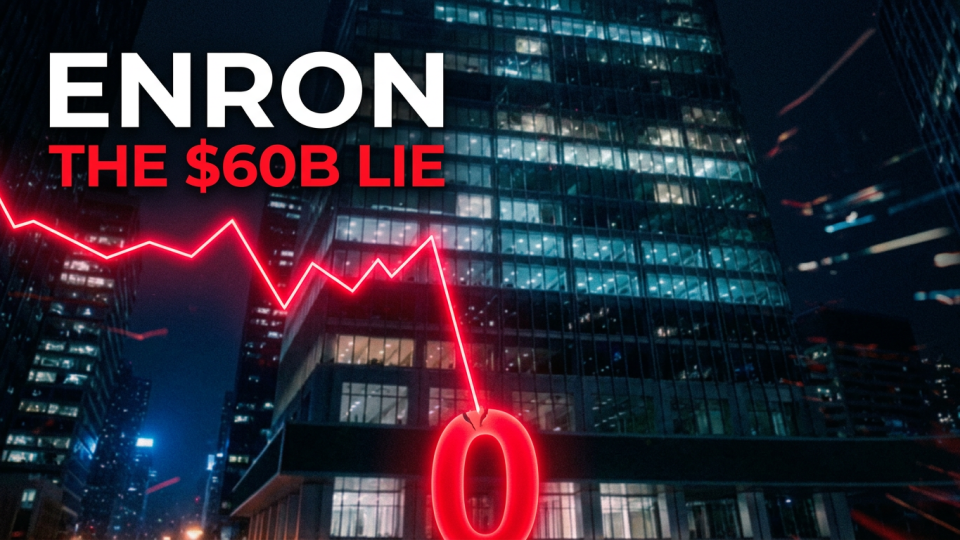
The $60 Billion Illusion | How Enron Fake-Traded Its Way to Zero
In 1990, Enron convinced the SEC to approve one obscure accounting rule. That single approval enabled the biggest corporate fraud in American history. Eleven years later, the 7th largest company in America filed for bankruptcy in 47 days — erasing $74 billion and destroying 20,000 jobs.
This is not just a story about greed. It is a story about a machine. A perfectly engineered accounting engine that required constant growth to survive — and carried its own self-destruct mechanism from the day it was built.
⚖️ The Mark-to-Market trick: In 1990, CEO Jeffrey Skilling convinced the SEC to let Enron book the estimated total profit of a 20-year energy contract on the day it was signed — not as cash arrived over 20 years. When the cash never materialized, Enron signed a bigger contract, used those estimated profits to cover the previous gap, and signed another. And another. It was a Ponzi scheme dressed in accounting language — and it required every new deal to be larger than the last just to maintain the illusion.
🏗️ The SPE network: When real losses accumulated — including a $900 million power plant in Dabhol, India, that the Indian government refused to pay for, and a failed broadband network — CFO Andrew Fastow built a network of off-balance-sheet shell companies. He named them after Star Wars characters: Chewco and JEDI. He named LJM1 and LJM2 after his own wife and children — Lea, Jeffrey, and Matthew. These entities absorbed Enron’s toxic assets and debt. Enron’s official balance sheet looked clean. The reality was $2.6 billion in hidden debt. Fastow personally collected at least $30 million in management fees from partnerships he controlled — a direct conflict of interest the Enron board waived on two separate occasions.
⚡ The California blackouts: In 2000, Enron traders developed strategies with internal codenames — “Death Star,” “Fat Boy,” “Get Shorty,” and “Ricochet” — to manipulate California’s deregulated energy market. They ordered power plants offline under the guise of routine maintenance, creating artificial scarcity. On December 15, 2000, California paid $1,400 per megawatt-hour for electricity — compared to $45 per megawatt-hour one year earlier. An 800% increase. Rolling blackouts affected 1.5 million customers in March 2001. Enron’s trading desk booked the profits.
💣 The built-in self-destruct: The SPE structure contained a fatal flaw. If Enron’s stock price dropped below a certain threshold, the shell companies would collapse, and every hidden debt would instantly transfer back to Enron’s books — a $1 billion debt cascade triggered automatically. This tripwire was built into the fraud from the beginning.
📰 The unraveling: In March 2001, Fortune journalist Bethany McLean published “Is Enron Overpriced?” — asking one simple question nobody could answer: how exactly does Enron make its money? In August 2001, VP Sherron Watkins sent CEO Kenneth Lay a memo warning that Enron might “implode in a wave of accounting scandals.” Lay did nothing. In October 2001, the tripwire was triggered. Enron reported a $638 million third-quarter loss. The stock fell. The SPEs collapsed. On November 8, 2001, Enron restated four years of financials — $586 million in profits erased, $2.6 billion in debt added. The stock fell from $90.75 to $0.26. On December 2, 2001, Enron filed for Chapter 11 bankruptcy with $63.4 billion in assets — the largest bankruptcy in American history at that time.
⚖️ The prosecutions: Jeffrey Skilling: 19 counts, convicted, 14 years in federal prison. Kenneth Lay: 6 counts, convicted, died July 2006 before sentencing — his conviction legally vacated by death. Andrew Fastow: pleaded guilty to 2 counts, cooperated with prosecutors, served 6 years, released in 2011 at age 50.
🏛️ The legacy: The Sarbanes-Oxley Act of 2002 — passed in direct response to Enron — requires every US public company CEO to personally certify financial accuracy under criminal penalty of up to 20 years in federal prison. It bans auditing firms from simultaneously consulting the same client. Every public company in America operates under these rules because of what happened in Houston.
