The Secret Superconductor Grid: How It Works
Right now, 5 to 7 percent of every watt of electricity generated in the United States disappears before it reaches your home — turning into heat inside the same basic copper wire technology Thomas Edison used in 1882. That wasted electricity could power over 20 million American homes every year for free.
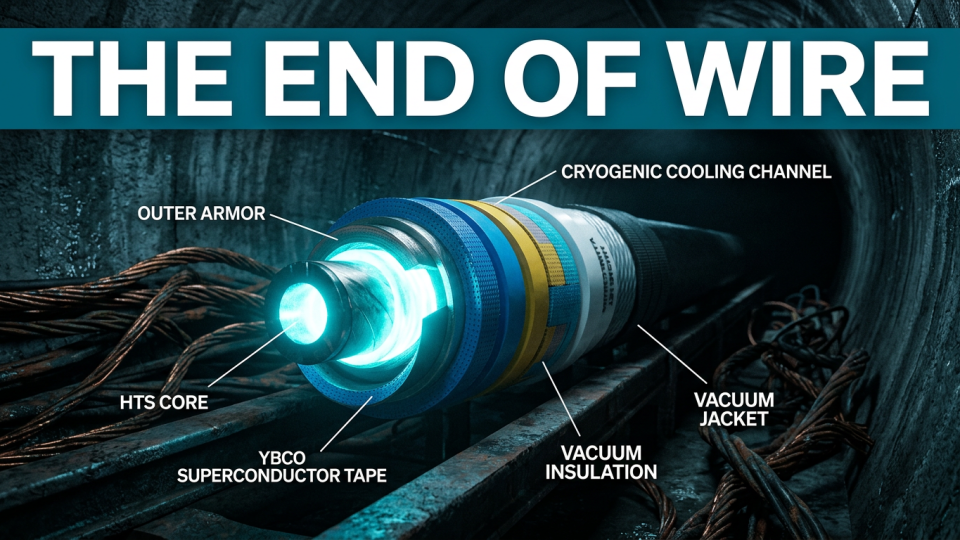
But underground in Munich, Essen, New York, and Chicago, engineers are already laying something completely different. A pipe filled with liquid nitrogen at minus 200 degrees Celsius — carrying 10 times more electricity than a conventional power line, in a fraction of the space, with zero resistance losses.
This is high-temperature superconducting cable technology. YBCO — yttrium barium copper oxide — carries 9,000 times more current than copper in the same cross-section. In Essen, the AmpaCity project has operated since 2014. In New York, the LIPA cable has carried 574 megawatts since 2008. Munich’s SuperLink — confirmed working in November 2024 — will be the world’s longest high-voltage HTS cable at 12 to 15 kilometers.
In February 2026, Microsoft publicly stated that power is the biggest bottleneck for AI systems, and that superconducting cables deliver an order-of-magnitude increase in capacity over conventional lines. By 2032, the superconducting cable market will be 48 times larger than today, growing at 76 percent per year.
Underground HTS cables are also immune to solar storms. A Carrington-level solar event could destroy large transformers that take 18 months to replace. Underground cables shielded by the Earth itself cannot collect geomagnetically induced currents. China ordered 640 kilometers of HTS cable in 2024 alone.
The holy grail remains room-temperature superconductivity — zero resistance with no cooling required. In 2023, LK-99 briefly convinced the world it had arrived. It had not. But the critical temperature record has risen from 4 Kelvin in 1911 to 288 Kelvin under pressure in 2020. The trend is unmistakable.
