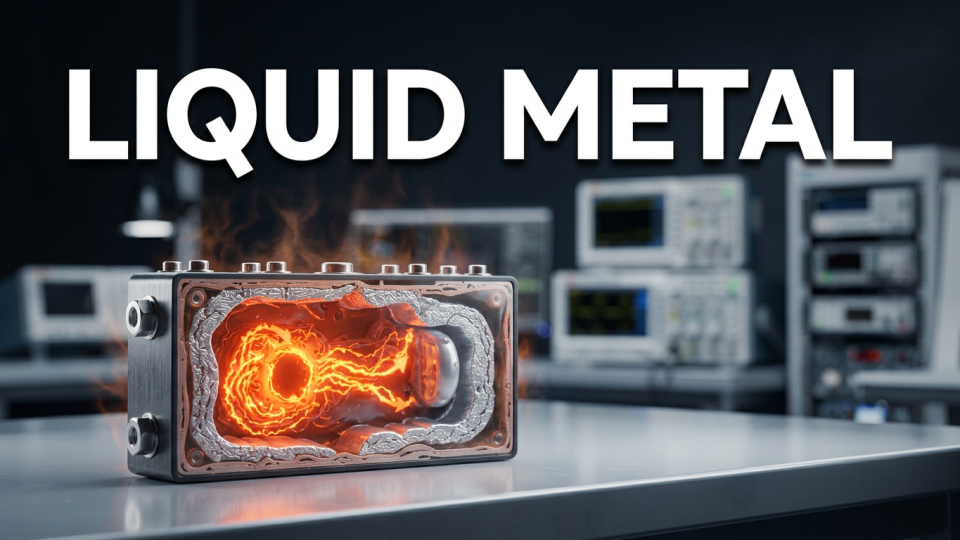
This Liquid Metal Battery Could Power Your Entire City
At 500 degrees Celsius, inside a sealed steel container, three liquid layers sit perfectly separated by density – liquid metal on top, molten salt in the middle, liquid metal on the bottom. Connect it to the power grid, and electricity flows out. No solid electrodes to crack. No separator membrane to replace. No thermal runaway possible. This is the liquid metal battery – the most elegant energy storage device ever designed. And the story of why it isn’t powering your city yet is one of the most instructive in clean energy history.
The science: Donald Sadoway at MIT noticed that electropositive metals – the ones that make ideal anodes – are naturally low density. Electronegative cathode metals are naturally high density. Nature arranged the periodic table so that the perfect liquid battery separates itself automatically, like a layered cocktail, with no manufactured separator needed.
Three liquid layers:
- 🔵 Top (anode): Liquid calcium alloy – low density, floats
- 🟡 Middle: Molten salt electrolyte – medium density
- ⚫ Bottom (cathode): Liquid antimony – high density, sinks
During discharge, calcium atoms release electrons (which flow out as electricity), and calcium ions cross the salt to alloy with the antimony at the bottom. Charging reverses the process. The chemical reactions generate enough heat to keep the metals liquid at 500°C – the battery runs its own furnace.
Why it can’t degrade: Liquid electrodes cannot crack under the stress of charge cycles the way solid lithium electrodes do. Dendrites – the crystal growths that kill lithium batteries – cannot bridge liquid layers. After 10,000 cycles, the electrode surface resets perfectly. This gives liquid metal batteries a projected 20+ year lifespan with near-zero capacity loss.
The grid storage problem it solves: MIT researchers calculated that grid storage must cost $20/kWh to make a 100% renewable grid economically viable. Today’s lithium-ion grid storage costs $100-400/kWh. Liquid metal batteries target $21/kWh at commercial scale – hitting the target that lithium cannot.
The commercial story – honestly told: Ambri, the MIT spinoff founded by Sadoway and David Bradwell in 2010, raised $200 million, including from Bill Gates. They achieved UL 1973 safety certification. They deployed a 300 kWh pilot at Xcel Energy’s SolarTAC facility in Aurora, Colorado – testing solar integration, frequency regulation, and energy arbitrage. The battery performed as designed. In May 2024, Ambri filed Chapter 11 bankruptcy. Reliance Industries declined to provide $8 million in bridge financing. The company could not cover its Massachusetts facility lease. Assets sold for $9.5 million. Relaunched under a lender consortium with co-founder Bradwell as CEO, then wound down in late 2025 after nearly 15 years.
The verdict: The science is real. The safety is proven (no thermal runaway – 500°C is safer than lithium-ion). The pilots worked. The manufacturing economics did not. Brilliant chemistry is necessary but not sufficient for commercial success. The research continues at MIT and universities worldwide. The question is not whether liquid metal batteries will find their commercial moment – it is when, and which company will build them.
