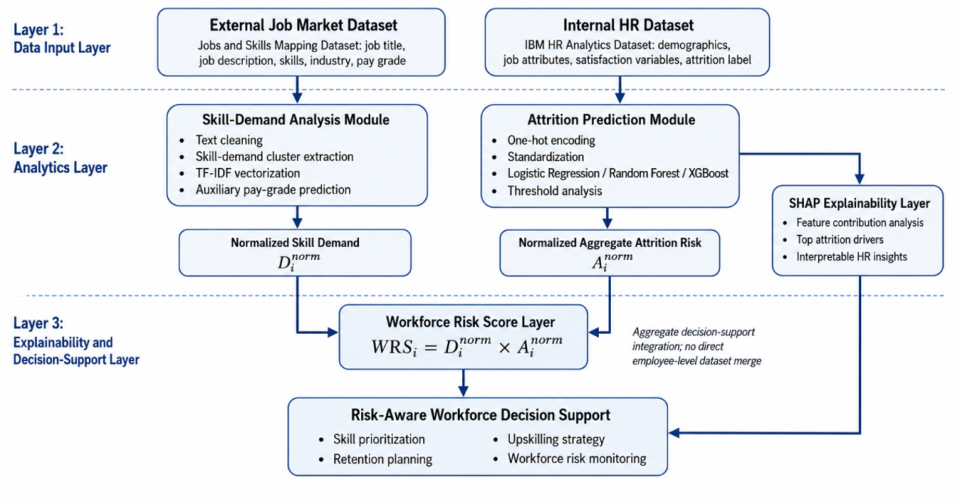
Paper Title: An explainable AI-based workforce intelligence framework for integrating future skill demand and employee attrition prediction with risk-aware decision analytics
Authors: Prathap D L, Thimmaraju S N
Corresponding Author: Prathap D L (prathapadl28@gmail.com)/ India
Abstract
Artificial intelligence supports workforce analytics by improving skill assessment, attrition prediction, and talent planning. However, external labor-market skill demand and internal employee attrition risk are often analyzed separately. This study presents a workforce intelligence framework based on explainable AI that combines skill-demand cluster analysis, attrition prediction, explainability (SHAP), and aggregate risk-aware decision support. Two public datasets were used: the Jobs and Skills Mapping for Career Analysis dataset and the IBM HR Analytics Employee Attrition Dataset. TF-IDF was applied to job-related text to generate clusters of job-required skills and to predict auxiliary pay grades, and Logistic Regression, Random Forest, and XGBoost were evaluated for attrition prediction. Logistic Regression was the best-performing model for identifying the risk of attrition, with a recall of 0.6170, an F1-score of 0.4328, and an ROC-AUC of 0.7954. The best recall and F1-score were obtained at a threshold of 0.40, with values of 0.7872 and 0.4901, respectively, as determined by threshold analysis. Over time, SHAP identified frequent business travel, job level, lab technician position, and total years of work as important factors in attrition. The Workforce Risk Score was a combination of normalized skill demand and normalized aggregate attrition risk, with the highest-ranked skill-demand cluster being moderate at 0.396. The framework provides actionable summary-level decision support for workforce planning.
