Paper Title: Transfer learning in neural networks: leveraging pre-trained models for improved performance
Authors: Abdul Sttar Ismail Wdaa, Iraq Ali Hussein, Ali Azeez Ahmed
Corresponding Author: Iraq Ali Hussein (iraqali@uodiyala.edu.iq)/ Iraq
Abstract
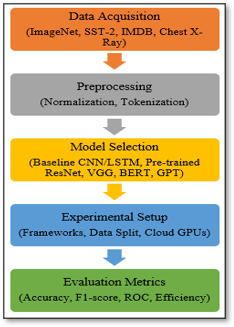
Transfer learning has become a key technique for improving the accuracy of neural networks in low-resource, low-data environments. The quantitative comparative analysis of the pre-trained models includes ResNet50, VGG16, BERT, GPT, and the baseline CNN and LSTM models. They are compared across three different application areas: computer vision, natural language processing (NLP), and medical imaging. The five benchmark datasets used were ImageNet, CIFAR-10, SST-2, IMDB, and Chest X-Ray. All experiments used the same preprocessing pipeline and evaluation metrics (accuracy, F1 score, precision, recall, and ROC-AUC). Results showed that models trained on the pre-trained data achieved consistently greater accuracy than the baselines in all domains (9-20%) and F1-score (0.09-0.16) gains. ResNet50 achieved 92% accuracy on CIFAR-10, compared to 72% for the CNN baseline, whereas BERT hit 92% on SST-2, with 80% accuracy for LSTM. VGG16 improved the accuracy of Chest X-Ray classification from 78% to 87% and reduced training time by up to 60%. There were a few instances of minor overfitting and domain mismatch, emphasizing the need for adaptive fine-tuning strategies. The results demonstrate that transfer learning significantly improves convergence speed, generalization, and computational efficiency, making it a promising approach for AI applications across domains such as healthcare, NLP, and autonomous systems.
