Paper Title: Securing national connectivity infrastructure through identity resilience: implications for zero trust–aligned telecom security
Authors: Shiva Kumara, Maunik Shah
Corresponding Author: Shiva Kumara (reachkumaras@gmail.com)/ India
Abstract
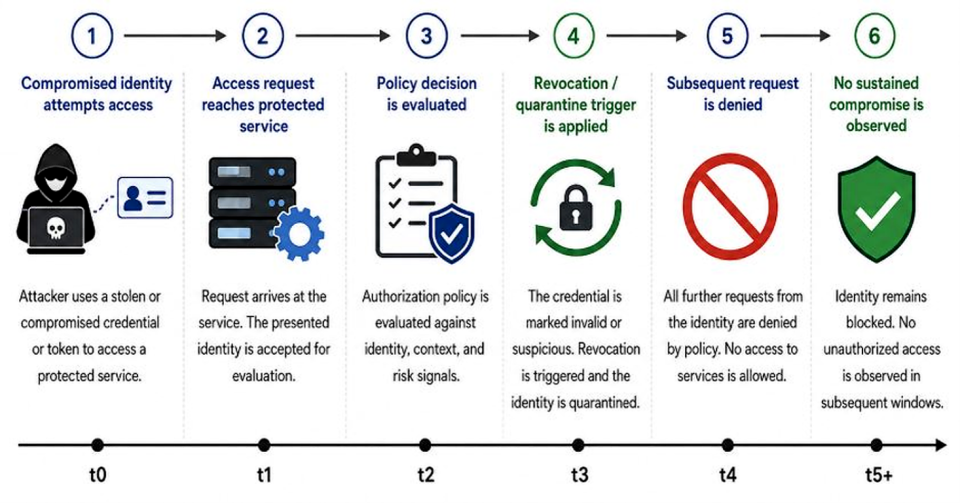
The importance of identity-centric controls for securing national connectivity infrastructure in cloud-native telecom environments is increasingly recognized. Modern telecom control planes are built on software-defined and service-based architectures. Identities are both a trust boundary and a significant attack surface. This study evaluates the effects of identity compromises on security and operational behavior in a simulated cloud-native telecom control plane. In this paper, we describe a scenario-based experimental approach to assessing three security postures: (i) perimeter-based, (ii) Zero Trust-based, and (iii) Zero Trust-based with basic identity-resilience mechanisms. Our findings demonstrate that perimeter-based security was bypassed in all evaluated attack scenarios and that it provided broad control-plane reachability. Zero Trust aligned security reduced attack success to less than 15% and limited lateral propagation. The attack success rate dropped to zero across all tested scenarios when identity resilience mechanisms were added. The average blast radius reduced from more than five services under perimeter security to near zero with identity-resilient Zero Trust. The measured request-success rate during attack and containment windows decreased from 100% under the perimeter baseline to 0% under the Zero Trust and identity-resilient configurations for unauthorized or quarantined requests. This decrease was primarily due to intentional policy-based denial rather than infrastructure failure. The results in the simulated environment show that identity resilience can enhance Zero Trust by reducing the persistence of compromised identities. The results also show the security-availability trade-offs, which must be further validated in telecom environments at production scale.
