Paper Title: Self-healing IoT infrastructure for intelligent transportation systems: a multi-city comparative analysis
Authors: Si Liu, Midhun Chakkaravarthy
Corresponding Author: Midhun Chakkaravarthy (midhun@lincoln.edu.my)/Malaysia
Abstract
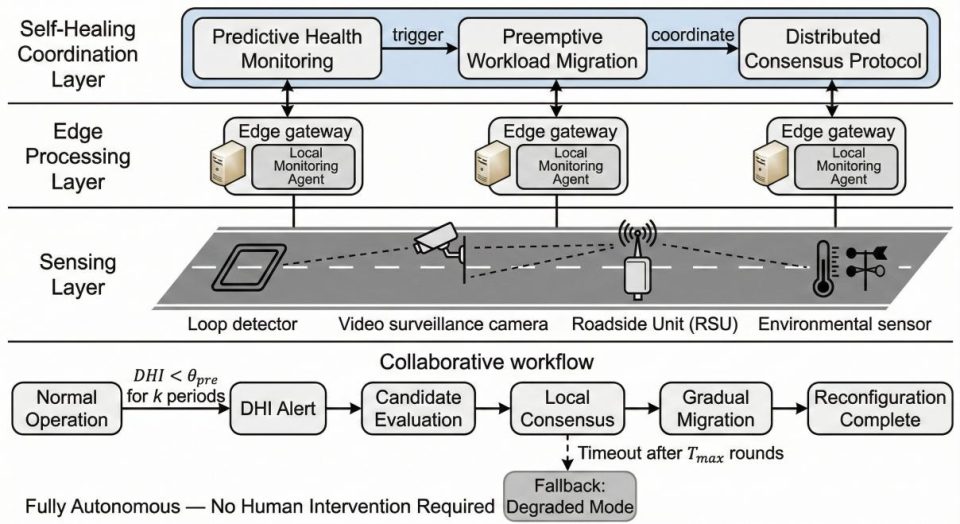
Intelligent transportation systems critically depend on reliable real-time data from thousands of distributed IoT sensors, yet current management frameworks lack autonomous recovery mechanisms to maintain service continuity during device failures or network disruptions. This paper presents a self-healing infrastructure architecture specifically designed for the transportation domain, where service interruptions can cascade into traffic congestion and safety hazards. The architecture integrates three complementary mechanisms: predictive health monitoring, which uses time-series anomaly detection to identify failing devices before complete failure; preemptive workload migration, which redistributes critical sensing tasks to neighboring devices based on predicted failures; and distributed consensus protocols, which enable rapid reconfiguration without centralized coordination. Unlike existing reactive approaches that respond to failures after service degradation occurs, our proactive strategy maintains service quality by anticipating and preventing disruptions. A key innovation lies in the domain-specific failure prediction models trained on operational patterns unique to transportation applications, incorporating factors such as vehicle vibration exposure, environmental stress, and communication interference patterns. Comparative analysis of multiple metropolitan transportation networks with varying levels of infrastructure maturity reveals that self-healing capabilities significantly reduce the frequency of service interruptions and recovery time compared to operator-managed systems. The findings demonstrate that transportation authorities can deploy larger sensor networks with fewer maintenance personnel by leveraging autonomous resilience mechanisms. This work provides practical guidelines for deploying fault-tolerant IoT systems in mission-critical urban services where reliability directly impacts public safety and urban mobility.
Keywords
Self-healing systems, IoT infrastructure, Intelligent transportation systems, Predictive maintenance, Distributed consensus
Cite:
Si Liu, Midhun Chakkaravarthy. 2026. “Self-healing IoT infrastructure for intelligent transportation systems: a multi-city comparative analysis”. Future Digital Technologies and Artificial Intelligence 2 (1):7-14. https://fupubco.com/fdtai/article/view/888.
