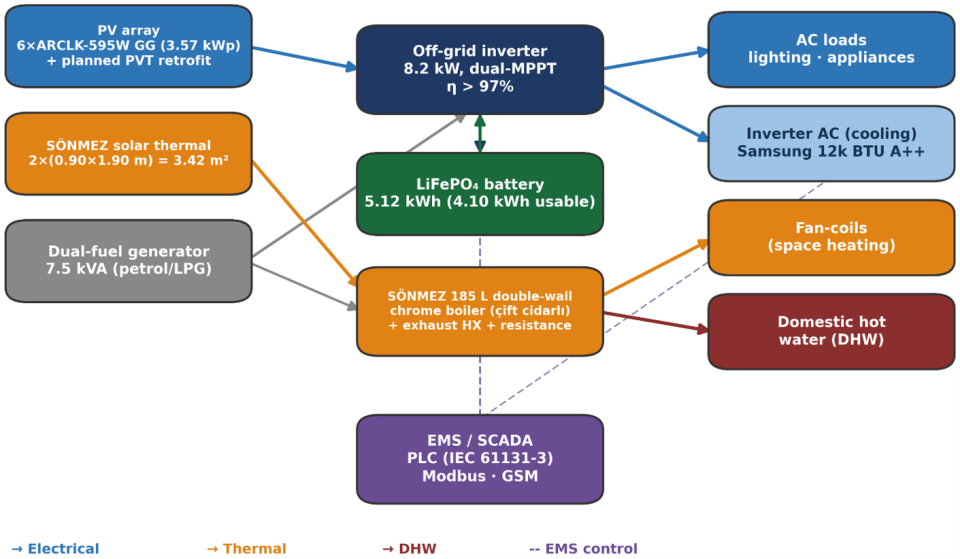
Paper Title: Integrated energy, exergy, and techno-economic analysis of an off-grid hybrid solar-battery-generator system for disaster-relief container homes in Ankara, Türkiye
Author: Kadir Aydin
Corresponding Author: Kadir Aydin (kadir.aydin@ostimteknik.edu.tr)/ Türkiye
Abstract
The 6 February 2023 Kahramanmaraş earthquakes (Mw 7.7 and Mw 7.6) left more than three million people homeless in Türkiye and, as of February 2025, over 649,000 people still reside in container settlements, for which reliable grid-independent energy provision remains an unsolved challenge. This paper presents the integrated design, first- and second law (energy and exergy) thermodynamic analysis, annual simulation, and techno-economic and environmental assessment of a mobile hybrid energy production, storage, and management system built for a 21 m² disaster-relief container home in Ankara (39.93°N), using commercially procured equipment. The system couples a 3.57 kWp array of six 595W glass–glass modules, with a planned roll-bond photovoltaic–thermal retrofit, a 5.12 kWh LiFePO₄ battery, an 8.2 kW dual-MPPT inverter, a 7.5 kVA dual-fuel generator with exhaust heat recovery, a 3.42 m² aluminium flat-plate solar-thermal field charging a 185 L (net) double-wall chromium boiler for domestic hot water and supplementary heating, and a single 12,000 BTU A++ inverter air conditioner dedicated to cooling (heat-pump heating retained only as emergency backup), all under a PLC-based EMS/SCADA. A 35° sawtooth mounting structure is designed, and its tilt optimization and inter-row shading are analyzed under the constraint of a 3 m roof depth. The annual electricity yield is 4,430 kWh (parallel-mounted), rising to 4,960 kWh at the 35° optimum, against ~1,740 kWh electrical demand, giving full summer autonomy and 60–85 h of winter generator run-time. The combined first-law efficiency reaches 68% in cogeneration mode; the overall second-law efficiency is ~24% (sustainability index 1.32), the low-temperature collector and the indirect double-wall boiler being the principal exergy-destruction sites. Against a continuous generator baseline, the system pays back in ~6 years and avoids ~2,770 kg CO₂/yr (~69 t over 25 years).
