Paper Title: Multi-agent reinforcement learning for Bai ethnic traditional dwelling protection in Dali: cultural identity-oriented community relationship optimization and urbanization adaptation algorithm
Authors: Xiaohua Qian, Neilson Ilan Mersat, Haslina Hashim, Bemen Wong Win Keong
Corresponding Author: Xiaohua Qian (qianxiaohua117@163.com)/Malaysia
Abstract
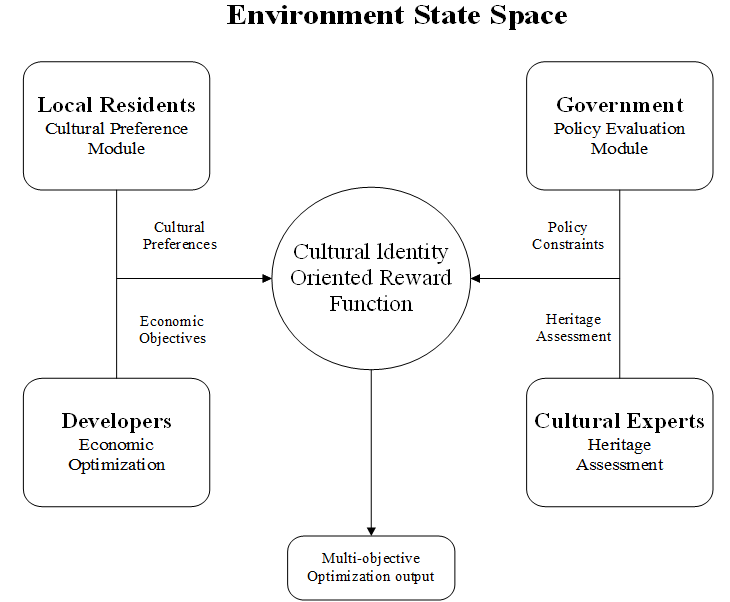
The preservation of residential architecture from traditional ethnic groups has never faced the types of challenges it does today due to urbanization. These challenges include the insufficient retention of landmarks due to competing stakeholder interests, which often leads to irreversible loss of cultural heritage. This research proposes a new culturally identity-oriented multi-agent reinforcement learning system for the protection of Bai ethnic traditional dwellings in Dali, Yunnan Province. The research combines diverse multi-source data collection approaches, including the building’s architecture and culture, urbanization statistics, and stakeholder networks, and develops an advanced computational framework in which every stakeholder category is embedded as an independent intelligent agent with specific behavioral patterns and autonomous decision-making skills. Specialized deep Q-networks of enhanced Q-value methods that consider cultural identity loss in Q-value calculus through loss function adjustments aimed at balancing cultural preservation and stakeholder appeasement were employed within the framework. Implementation results show performance with an overall accuracy of 89.3% for implementation and 87.2% for cultural preservation effectiveness. Conventional approaches previously achieved significantly lower accuracy within these parameters, 15-25 percentage points. Enhancements in cultural identity increase from a baseline of 58.3% to optimized values of 91.2%, while community satisfaction improves from 54.7% to 86.4%. The framework maintains coordination indices above 85% for all stakeholder groups, showing scalability with over 85% replication success rates for populations between 5,000 and 50,000 residents. This demonstrates theoretical and practical value in the use of AI concerning culturally aware heritage preservation.
Keywords
Multi-agent reinforcement learning, Cultural heritage preservation, Cultural identity, Traditional architecture, Stakeholder coordination
