1. Message from the Editorial Board
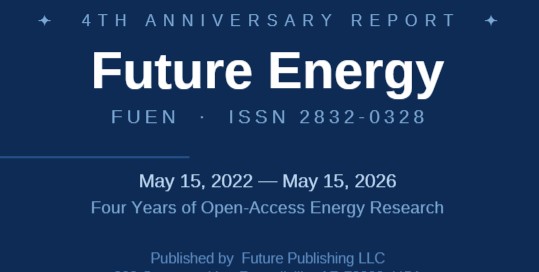
On May 15, 2026, Future Energy (FUEN) celebrates its fourth anniversary, a milestone that reflects four years of unwavering dedication to advancing the frontiers of energy science, engineering, and policy. What began as a vision for a rigorous, globally accessible, open-access scientific platform has grown into a recognized international forum drawing researchers from every corner of the world.
From the first paper published in May 2022 to the 86th and beyond, FUEN has remained committed to one purpose: accelerating the exchange of scientific knowledge in the energy field at a time when the world needs it most. This anniversary report chronicles our journey, our community, and our vision for what comes next.
2. About Future Energy: Aims, Scope, and Role in Global Energy Research
Future Energy (FUEN) is a peer-reviewed, fully open-access scientific journal published quarterly by Future Publishing LLC, headquartered in Arkansas, USA. The journal was formally launched on May 15, 2022, and has since published research from authors representing more than 30 countries across six continents.
At a time when the global transition to clean energy is one of the defining challenges of our era, with governments, industry, and academia united around decarbonization, net-zero commitments, and energy security, FUEN serves as a dedicated scientific forum where the most pressing questions in energy research are explored, debated, and advanced.
2.1 Thematic Scope
FUEN welcomes original research articles, comprehensive review papers, and technical communications on outstanding energy-related topics, including but not limited to:
New Energy Systems and Cutting-Edge Applied Areas Renewable and sustainable energy; clean energy conversion, distribution, and utilization; hydrogen production, delivery, and utilization; energy storage; smart and flexible system integration and optimization; global warming and climate change mitigation; and sustainability in energy systems.
Energy Systems Characteristics Integrated energy systems spanning industry, transport, and buildings; advanced energy conversion techniques; combustion systems and emission mitigation; smart grids and mini/microgrids; distributed energy systems.
Energy Synergy with Global Challenges Energy–emissions nexus; energy–transportation; energy–water; waste-to-energy; the flexibility of renewable energy systems; energy economics and policy.
2.2 Why FUEN Matters
The urgency of the global energy transition makes FUEN’s mission more important every year. The IEA estimates that global clean energy investment must reach $4 trillion annually by 2030 to meet net-zero targets. Behind every dollar of that investment is a body of scientific research informing engineering decisions, policy choices, and technology pathways. FUEN contributes directly to that scientific foundation, removing financial barriers to publication through its APC waiver, removing access barriers through full open access, and maintaining research quality through rigorous double-blind peer review.
3. Editorial Board: A World-Class International Scientific Community
The credibility and scientific direction of any journal rest fundamentally on the quality and commitment of its editorial team. FUEN’s editorial board is one of its strongest assets: 27 distinguished researchers drawn from leading institutions across 18 countries on five continents, with collective expertise spanning every dimension of energy science and engineering.
3.1 Highly Cited and Internationally Recognized Members
Several FUEN editorial board members are recognized among the world’s top 2% most-cited researchers in their fields- a distinction awarded annually by Stanford University and Elsevier based on career-long and single-year citation impact metrics.
3.2 Full Editorial Board
| Name | Institution | Country |
|---|---|---|
| Seyed Ehsan Hosseini, PhD (Editor-in-Chief) | Arkansas Tech University | USA |
| Su Shiung Lam, PhD | Universiti Malaysia Terengganu | Malaysia |
| Henrik Lund, PhD | Aalborg Universitet | Denmark |
| Wei-Hsin Chen, PhD | National Cheng Kung University | Taiwan |
| Mattheos Santamouris, PhD | University of New South Wales | Australia |
| Mengxia Liu, PhD | Yale University | USA |
| Nurkhat Zhakiyev, PhD | Harvard University | USA |
| Jeongmin Ahn, PhD | Syracuse University | USA |
| Sohrab Zendehboudi, PhD | Memorial University | Canada |
| Yonghee Kim, PhD | KAIST | South Korea |
| Daniela Gogova, PhD | Linköping University | Sweden |
| Luis M. Fernández-Ramírez, PhD | Universidad de Cádiz | Spain |
| Manfred Lange, PhD | The Cyprus Institute | Cyprus |
| Mamdouh El Haj Assad, PhD | University of Sharjah | UAE |
| Raffaello Cozzolino, PhD | University of Niccolò Cusano | Italy |
| Siamak Hosseinzadeh, PhD | Sapienza University of Rome | Italy |
| Abolfazl Ahmadi, PhD | Iran University of Science & Technology | Iran |
| Ao Xia, PhD | Chongqing University | China |
| Yingru Zhao, PhD | Xiamen University | China |
| Shou-Heng Liu, PhD | National Cheng Kung University | Taiwan |
| Amin M. Andwari, PhD | University of Oulu | Finland |
| Serhat Karyeyen, PhD | Gazi University | Turkey |
| Dhrubajyoti Bhattacharjya, PhD | CSIR-NEIST | India |
| Anil Singh Yadav, PhD | Bakhtiyarpur College of Engineering | India |
| Eriola Betiku, PhD | Obafemi Awolowo University | Nigeria |
| Dimitrios Rakopoulos, PhD | CERTH | Greece |
| Sajal K. Das, PhD | RUET | Bangladesh |
4. Citation Impact and Global Visibility
| Metric | Value |
|---|---|
| Total citations (Google Scholar, May 2026) | 724 |
| Average citations per paper | ~8.4 |
| Citations from ISI/Scopus journals | 400+ |
| Email distribution per issue | 50,000+ researchers |
| Countries represented by authors | 30+ |
4.1 Citation Profile
According to Google Scholar data as of May 2026, Future Energy has accumulated 724 total citations across its 86 published papers — an average of approximately 8.4 citations per article. Most importantly, more than 400 of these citations originate from prestigious ISI Web of Science and Scopus-indexed journals, confirming that FUEN’s content is being integrated into the mainstream scientific literature of the energy field.
This citation footprint, achieved within just four years of publication, is a testament to the quality of FUEN’s published research and the effectiveness of its global dissemination strategy. Several individual articles have attracted between 500 and 2,500 full-text views, demonstrating genuine readership far beyond citation counts alone.
4.2 Global Dissemination: Reaching 50,000+ Researchers Per Issue
Email campaigns: Following each quarterly issue, FUEN distributes a comprehensive email campaign to over 50,000 verified email addresses of active energy researchers, academics, and practitioners worldwide. This curated mailing list — built and maintained over four years, represents one of the most direct and effective outreach mechanisms available, placing every published paper in front of a global audience of relevant specialists immediately upon publication.
LinkedIn: Each issue and individual articles are promoted through Future Publishing LLC’s LinkedIn presence, reaching thousands of professionals in the energy, engineering, and academic communities worldwide.
Website traffic: The journal’s website (www.fupubco.com/fuen) consistently records high visitor numbers, with articles in high-demand research areas regularly attracting thousands of full-text views — confirming that FUEN’s open-access model is successfully delivering research to global readers at no cost.
5. Publication Standards and Journal Policies
5.1 Review Process
FUEN employs a rigorous double-blind peer review process, in which neither authors nor reviewers are aware of each other’s identities:
- All submissions are initially assessed by the Editorial Board for scope and originality, and screened for plagiarism using Turnitin.
- Papers deemed suitable are sent to at least three independent reviewers, recruited from outside the authors’ home institution.
- Two negative reviews result in rejection. If one review is negative and two are positive, a fourth reviewer is consulted.
- The Editorial Board holds the final decision on acceptance or rejection.
- The full review process typically takes 5–7 weeks from submission to decision.
5.2 Publication Frequency
FUEN publishes four issues per year — in February, May, August, and November — on a consistent quarterly schedule maintained without interruption since May 2022. By the time of the Scopus application in December 2026, the journal will have 18 consecutive on-schedule issues — a mark of operational maturity that indexing bodies value highly.
5.3 Open Access
All articles in Future Energy are made freely available online immediately upon publication under the Creative Commons Attribution 4.0 International License (CC BY 4.0). Readers worldwide may freely read, download, copy, distribute, and reuse any published article, provided appropriate attribution is given. There are no subscription fees, no paywalls, and no embargo periods.
5.4 Article Processing Charges — Currently Fully Waived
🎉 $0 APC — All Article Processing Charges Waived Until December 2026
In a significant initiative to support the global research community, Future Publishing LLC has announced a complete waiver of the $500 USD Article Processing Charge for all manuscripts submitted to Future Energy and accepted for publication by December 2026. There are no submission fees, no page charges, and no color or formatting fees. Authors are invited to take full advantage of this rare opportunity: publish high-quality, open-access research in an international peer-reviewed journal at absolutely no cost.
5.5 Publication Ethics
FUEN’s publication ethics framework aligns with the guidelines of the Committee on Publication Ethics (COPE) and covers all parties in the publishing process. Key commitments include submitting only original work, transparent disclosure of conflicts of interest and funding sources, objective and confidential peer review, and editorial decisions based solely on scientific merit. The journal applies clear policies for corrections, retractions, and expressions of concern.
5.6 Plagiarism Policy
Originality is a non-negotiable requirement. All submitted manuscripts are screened using Turnitin prior to peer review. Manuscripts demonstrating excessive similarity to previously published work — including whole-text plagiarism, partial plagiarism, or self-plagiarism — are rejected without external review.
5.7 Generative AI (GenAI) Policy
In alignment with COPE, ICMJE, Elsevier, and Springer Nature guidelines, FUEN maintains a formal Generative AI policy. Authors who use GenAI tools must disclose this in a dedicated statement. AI tools may not be listed as authors or co-authors. GenAI must not be used to fabricate data, hallucinate references, or generate core scientific conclusions without human intellectual oversight.
5.8 DOI Assignment, Indexing, and Archiving
A unique Digital Object Identifier (DOI) is assigned to every published article, ensuring permanent and citable access. FUEN is currently indexed in:
Google Scholar · BASE · WorldCat · Scilit · Crossref · Dimensions · Semantic Scholar · ScienceOpen · EuroPub · JUFO Portal
Full-text archiving of all FUEN content is maintained through archive.org (Internet Archive), ensuring that all published articles remain permanently accessible, safeguarding the scientific record for future generations.
6. The Road to Scopus — December 2026
Indexing in Scopus, the world’s largest abstract and citation database, covering over 27,000 peer-reviewed journals, represents a defining milestone in a journal’s development. It signals to the global research community that a journal meets the highest standards of editorial quality, ethical practice, author diversity, citation impact, and publication regularity.
Future Energy is targeting a formal Scopus CSAB application in December 2026 and is well-positioned across all five evaluation categories:
| CSAB Criterion | FUEN Status |
|---|---|
| Publication history | 4+ years of uninterrupted quarterly publication |
| Citation impact | 724 citations; 400+ from Scopus/ISI journals |
| Editorial board | 27 members with Scopus IDs from 18+ countries |
| Ethics & peer review | Double-blind, Turnitin, COPE-aligned, GenAI policy |
| Open access & DOI | Full CC BY 4.0 with DOI, Crossref, and archiving |
| Author geography | Authors from 30+ countries across 6 continents |
Note for authors: Publishing in FUEN now means your work will be part of the Scopus-indexed record from the moment indexing is confirmed. Authors benefit from the enhanced discoverability and citation visibility that Scopus indexing provides.
7. Call for Papers — Submit Your Research Today
Future Energy warmly invites original research contributions from energy researchers worldwide. We welcome full-length original research articles, comprehensive review papers, and focused technical communications across all areas of energy science and engineering.
Why Publish in Future Energy?
✅ $0 APC until December 2026 — Publish open-access at no cost whatsoever ✅ Rapid peer review — Editorial decision within 5–7 weeks ✅ True open access — Immediate CC BY 4.0 availability for all readers worldwide ✅ Global reach — Your paper distributed to 50,000+ researchers per issue via email, and promoted on LinkedIn ✅ High citation visibility — 724 citations in 4 years, predominantly from ISI/Scopus journals ✅ Rigorous quality — 3+ reviewers, Turnitin screening, DOI assignment, COPE-aligned ethics ✅ Permanent archiving — Full-text archived forever at archive.org ✅ Scopus-targeting journal — Application December 2026
How to Submit
| Portal | fupubco.com/fuen |
| fuen@fupubco.com | |
| Phone | +1 (619) 510 9792 |
| APC | $0 — fully waived until December 2026 |
| Review type | Double-blind |
| Decision time | 5–7 weeks |
8. Key Facts at a Glance
| Full name | Future Energy (FUEN) |
| Publisher | Future Publishing LLC, Arkansas, USA |
| ISSN | 2832-0328 (Online) |
| Founded | May 15, 2022 |
| Anniversary | May 15, 2026 (4th) |
| Editor-in-Chief | Dr. Seyed Ehsan Hosseini |
| Frequency | Quarterly (Feb, May, Aug, Nov) |
| Papers published | 86 |
| Total citations | 724 (Google Scholar) |
| APC | $0 — waived until December 2026 |
| License | CC BY 4.0 |
| Review | Double-blind, 5–7 weeks |
| Plagiarism screening | Turnitin |
| Archiving | archive.org |
| Scopus target | December 2026 |
| Email reach | 50,000+ researchers per issue |
| Website | fupubco.com/fuen |
© 2026 Future Publishing LLC · ISSN 2832-0328 · Published under CC BY 4.0 Future Energy (FUEN), USA
