The Secret Manufacturing Process of the World’s Strongest Magnet
The magnet on your fridge holds up a shopping list. The magnet inside a Tesla motor generates enough torque to accelerate a two-tonne car in under three seconds. Both are permanent magnets. But they are made by completely different processes — and the gap between them is one of the most important manufacturing stories of the 21st century.
In 2025, the world produces over 200,000 tonnes of permanent magnets every year. Remove them, and every electric vehicle stops. Every wind turbine stops. Every MRI machine goes dark. The hard drive in every computer stops spinning. Permanent magnets are the invisible infrastructure of modern civilization — and almost nobody knows how they are made.
The complete manufacturing journey:
The recipe: Neodymium (29%) + Iron (70%) + Boron (1%) = Nd₂Fe₁₄B — the world’s strongest permanent magnet. Neodymium comes primarily from Inner Mongolia. Iron is the most common metal on Earth. Boron locks the crystal lattice into its magnetic configuration.
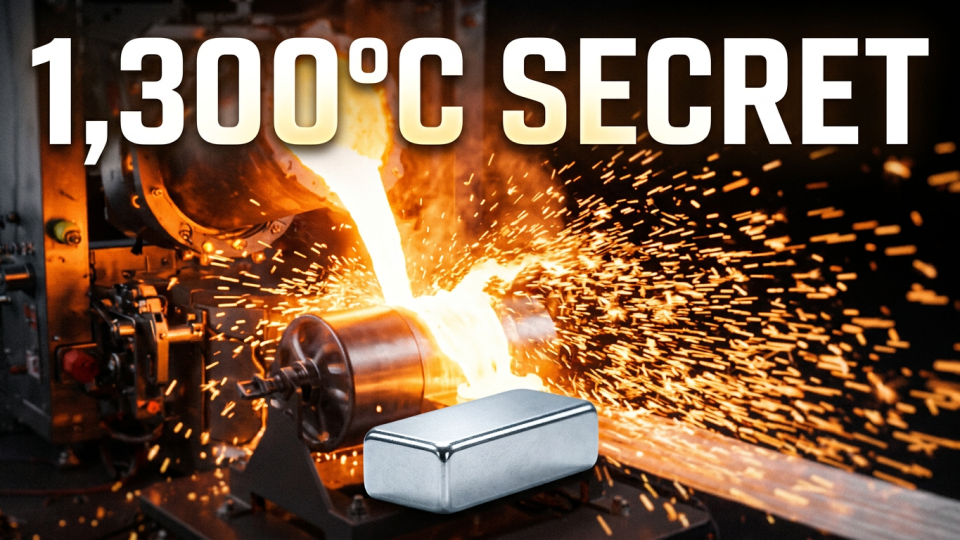
The forge: The three ingredients are loaded into a vacuum induction furnace at 1,300°C and melted together for over four hours in a completely oxygen-free environment. Any oxygen contamination ruins the entire batch. The liquid alloy is then rapidly cooled onto a strip casting roller into thin ribbons.
The powder: Alloy ribbons are shattered into coarse powder using hydrogen decrepitation — hydrogen gas infiltrates the crystal structure and crumbles it along natural grain boundaries, like peeling apart a croissant. The coarse powder is then jet-milled in nitrogen gas to a target particle size of just 3–4 microns — roughly one thirtieth the width of a human hair. Throughout this entire process, the powder must never touch air. Neodymium powder is pyrophoric: it spontaneously ignites in oxygen. The entire factory runs on nitrogen.
The alignment: The 3-micron powder is placed in a mould and subjected to a powerful external magnetic field that forces every microscopic particle to rotate and align its magnetic axis in exactly the same direction. The mould is then pressed at 150–250 MPa — 2,500 times atmospheric pressure. The result is a “green body” — a fragile, aligned powder block.
The sinter: Green bodies are sintered in a vacuum furnace at 1,000–1,100°C. Particles fuse at their surfaces over several hours, densifying into solid metal and shrinking 15–20%. Two stages of tempering follow — first at 880–950°C for 3 hours, then 440–640°C for 4 hours — adjusting the microstructure to maximize coercivity: the magnet’s resistance to losing its field.
The moment: A single powerful pulse of electricity through a magnetizing coil activates the permanent field. In an instant, the domains lock. The block of metal becomes a magnet.
The finish: Diamond-coated grinding wheels machine the magnet to final dimensions with water cooling — NdFeB is extremely brittle. A nickel-copper-nickel electroplating coat protects against corrosion. Without it, neodymium rusts within weeks. Grade is stamped: N35 to N52 — the higher the number, the stronger the magnet.
The danger: Large neodymium magnets are genuinely dangerous. Two book-sized magnets 30cm apart will snap together with enough force to crush fingers. They shatter on impact like glass. Only trained personnel handle magnets above a few kilograms.
The stakes: China processes approximately 90% of global rare earth supply and produces a dominant share of finished magnets. Every EV, every wind turbine, every MRI machine depends on this supply chain. The magnet supply chain has become one of the most geopolitically contested industrial dependencies of the 21st century.
