Inside the Dry Ice Cold Chain | The Ice That Skips Liquid and Powers Modern Life
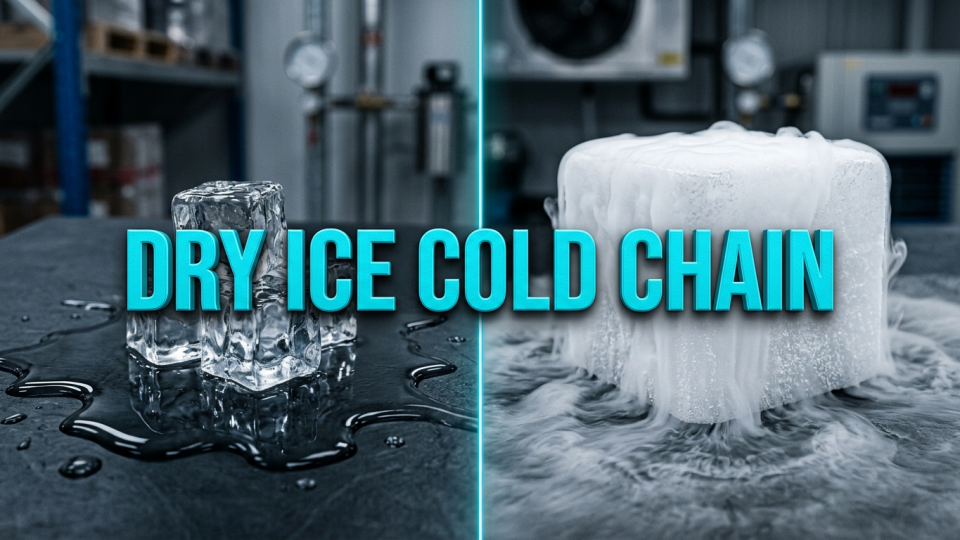
Place a block of dry ice in warm water. A thick white fog cascades over the edge and rolls across the floor. This is not steam. It is frozen water droplets forming as solid carbon dioxide converts directly into gas — skipping the liquid phase entirely. That single property makes dry ice one of the most valuable materials in modern logistics. When Pfizer’s mRNA COVID-19 vaccine required storage at -70°C, dry ice was the only solution. Demand increased by 1,138% overnight.
This video covers the complete story – from the triple point physics that explains why CO2 cannot form a liquid at normal pressure, to the four-stage factory process of making dry ice, to the cold chain engineering that delivered billions of vaccine doses around the world.
What you will learn:
🔬 The science of sublimation: Why the CO2 triple point at 5.1 atmospheres means liquid CO2 simply cannot exist at normal pressure – and why the linear, nonpolar CO2 molecule makes sublimation inevitable.
🏭 The four-stage factory process:
- Capture – CO2 is collected as a byproduct of ammonia synthesis, ethanol fermentation, and petroleum refining. Rather than being vented into the atmosphere, it is captured and purified to food-grade or pharmaceutical-grade standards through amine scrubbing, drying, and activated carbon filtration.
- Expansion – Purified liquid CO2 stored at 20 bar is passed through a precisely controlled expansion valve. The sudden pressure drop causes approximately 50% to flash-freeze into CO2 snow at -78.5°C. No external refrigerant is needed — the expansion itself creates the cold.
- Pressing – CO2 snow is loaded into rectangular moulds and compressed under hydraulic presses at 1,000–1,500 psi (70–100 bar), densifying it into solid blocks. Alternatively, snow is extruded through die plates to produce 3mm pellets (for dry ice blasting) or 16mm pellets (for shipping).
- Quality control – density, purity, and sublimation rate are tested before insulated packaging and temperature-monitored dispatch.
The vaccine cold chain: Pfizer’s mRNA vaccine required -70°C storage. Each thermal shipping carton held up to 4,875 doses packed with 23 kg of dry ice. Pfizer invested $2 billion in logistics and packaging solutions so efficient that Boeing had to extend its aircraft dry ice loading reference charts below 1% sublimation rate — a range it had never needed before. A Boeing 777-300 that could carry 3,200 lbs of standard dry ice shipments could carry 12,500 lbs of Pfizer’s packaging.
Frozen food logistics: Dry ice sublimates up to 10% of its mass per day in ambient conditions. Better insulation slows this dramatically. Cold chain engineers calculate the precise quantity needed per shipment, per journey duration, per ambient temperature — with zero margin for error.
Dry ice blasting: 3mm pellets are accelerated to sonic velocity by compressed air. Three mechanisms act simultaneously on impact: kinetic energy shatters contamination, -78.5°C thermal shock cracks it, and rapid gas expansion blows fragments away. The pellets sublime on impact — no secondary waste, no moisture, no chemicals. Ideal for electrical equipment, food processing machinery, aircraft components, and historical artefacts.
Hollywood fog: Drop dry ice into warm water. CO2 sublimates and chills surrounding air, condensing water vapour into tiny droplets — visible white fog. CO2 is denser than air, so the fog stays at ground level. Every haunted house, every concert, every horror film uses this effect.
Safety: Two serious hazards. Frostbite — -78.5°C causes instant tissue damage on bare skin; always use insulated gloves. Asphyxiation — CO2 is odourless, colourless, and heavier than air; it pools silently in confined spaces and displaces oxygen without warning. Never store dry ice in a sealed container. Never transport in a poorly ventilated vehicle.
The sustainable future: In July 2025, Cold Jet unveiled a system allowing biomethane facilities to generate dual revenue streams by integrating direct carbon capture with dry ice production. The global dry ice market stands at $6.4 billion in 2025 and is projected to reach $14 billion by 2034.
