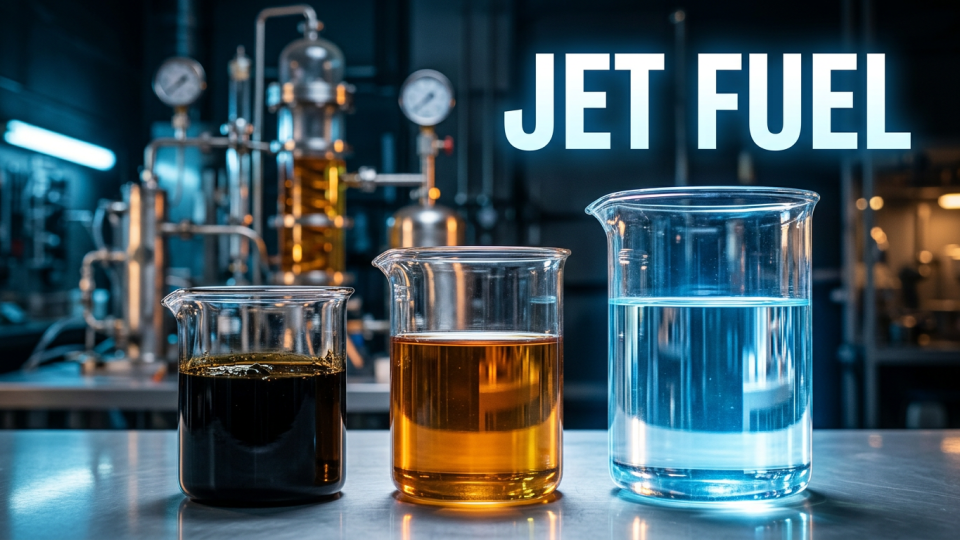
Transforming Low Grade Crude Into High Performance Jet Fuel
How do you transform crude oil with 3.5% sulfur — enough to destroy a jet engine in minutes — into Jet A-1 fuel that must survive -47°C at 40,000 feet? The answer requires running hydrogen at 2,900 PSI through chains of carbon atoms over a catalyst with the surface area of a tennis court per teaspoon. This is not simple refining. It is molecular engineering — five distinct stages that break, clean, and reshape hydrocarbon chains until a precisely specified aviation fuel emerges from what began as the world’s dirtiest crude.
The complete molecular engineering story:
Why heavy crude is a problem: Heavy sour crude sits below 22° API gravity and contains up to 3.5 wt% sulfur in complex organic forms — thiols (R-SH), sulfides (R-S-R), and disulfides. These molecules are simultaneously too large for aviation (C₂₀–C₅₀ chains vs the C₁₀–C₁₆ kerosene range) and too contaminated. In a jet engine combustor at 1,300°C, sulfur compounds oxidize to SO₂, which reacts with moisture to form sulfuric acid- a turbine-blade corrosive. Jet A-1 specifies a maximum of 3,000 ppm total sulfur. Heavy sour crude starts at 3.5% — that is 35,000 ppm. Every sulfur atom must be individually removed.
Stage 1: Atmospheric distillation: Heavy crude is heated to 350°C and fed into the base of a 60-meter distillation column. As vapors rise, lighter fractions condense at different heights. The kerosene side draw — boiling range 130–300°C, the C₁₀–C₁₆ jet fuel precursor — exits at approximately one-third height. But atmospheric distillation alone cannot process the heaviest fractions — typically 40–60% of the crude’s energy leaves with the atmospheric residue.
Stage 2: Vacuum distillation: The atmospheric residue enters a vacuum distillation unit operating below 10 mbar — approximately 1% of atmospheric pressure. At this near-vacuum, heavy molecules vaporize at lower temperatures without thermal cracking that would destroy their structure. The vacuum gas oil (VGO) produced is the primary feedstock for the hydrocracker.
Stage 3: Hydrocracking at 200 bar: Hydrogen is compressed to 100–200 bar (1,450–2,900 PSI) and mixed with the VGO feedstock. This combined stream passes over a zeolite Y catalyst bed at 400–450°C. Zeolite Y’s internal micropore structure provides over 500 m² of active surface area per gram — the entire surface area of a tennis court in a teaspoon of catalyst powder. The acidic silicon-aluminum sites at the pore walls cleave carbon-carbon bonds, breaking C₂₀–C₅₀ chains into C₁₀–C₁₆ fragments. Single-stage hydrocracking achieves 77–79% jet fuel yield from feedstock. US hydrocracking capacity stands at 2,427,400 barrels per day in 2025, with capital expenditure exceeding $10 billion in the past two years.
Stage 4: Hydrodesulfurization: The kerosene cut passes through a fixed-bed reactor containing a cobalt-molybdenum (CoMo) catalyst. The reaction: R-SH + H₂ → R-H + H₂S removes sulfur atom by atom as hydrogen sulfide gas. The H₂S is captured downstream in a Claus sulfur recovery unit, converted to elemental sulfur, and sold as industrial feedstock. A second hydrotreating stage removes nitrogen compounds (which would form NOₓ at combustion temperatures, contributing to ozone depletion), oxygen compounds (which reduce thermal stability), and trace metal contaminants (vanadium and nickel, which poison catalysts).
Stage 5: Isomerization: The remaining problem is molecular geometry. Straight-chain n-paraffins — long linear carbon chains — pack together tightly when cooled, crystallizing at around -30°C. This is 17°C too warm for Jet A-1’s -47°C freeze point maximum. A platinum-zeolite isomerization catalyst rearranges the straight chains into branched isoparaffins — same molecular formula, different geometry. Branched molecules cannot pack tightly, suppressing crystallization to -55°C. Energy content remains unchanged at 43.2 MJ/kg.
Jet A-1’s five simultaneous specifications (ASTM D1655): Freeze point maximum -47°C. Flash point minimum +38°C. Density 775–840 kg/m³ at 15°C. Total sulfur maximum 3,000 ppm. Kinematic viscosity at -20°C: 1.2–8.0 mm²/s. Every molecular engineering decision affects all five simultaneously. Fail any one and the entire batch is rejected before it can be loaded into an aircraft.
The strategic shift: Global conventional light sweet crude production peaked around 2005 and has been declining since. Heavy crude reserves in Venezuela’s Orinoco Belt, Canada’s Alberta oil sands, Mexico, and Iraq are filling the gap — but only for refineries with sophisticated hydrocracking capability. Nations that invest in this molecular engineering technology narrow the historical price discount for their heavy crude reserves. The technology that upgrades molecules also upgrades geopolitical leverage.
Sustainable Aviation Fuel: The HEFA (Hydroprocessed Esters and Fatty Acids) pathway for SAF uses identical hydrocracking, hydrotreating, and isomerization chemistry applied to biological feedstocks — waste cooking oils, agricultural residues, and municipal waste. The molecular engineering is unchanged. The carbon source is renewable. Lifecycle CO₂ reductions of up to 80% versus fossil jet fuel are achievable.
Next-generation catalysts: Current commercial hydrocrackers operate at 100–200 bar. New ionic liquid catalysts and metal-organic framework (MOF) materials are being developed at pilot scale to achieve equivalent C₁₀–C₁₆ selectivity at pressures below 50 bar — a potential 60% reduction in hydrogen compression energy, dramatically reducing refinery operating costs per barrel of jet fuel produced.
