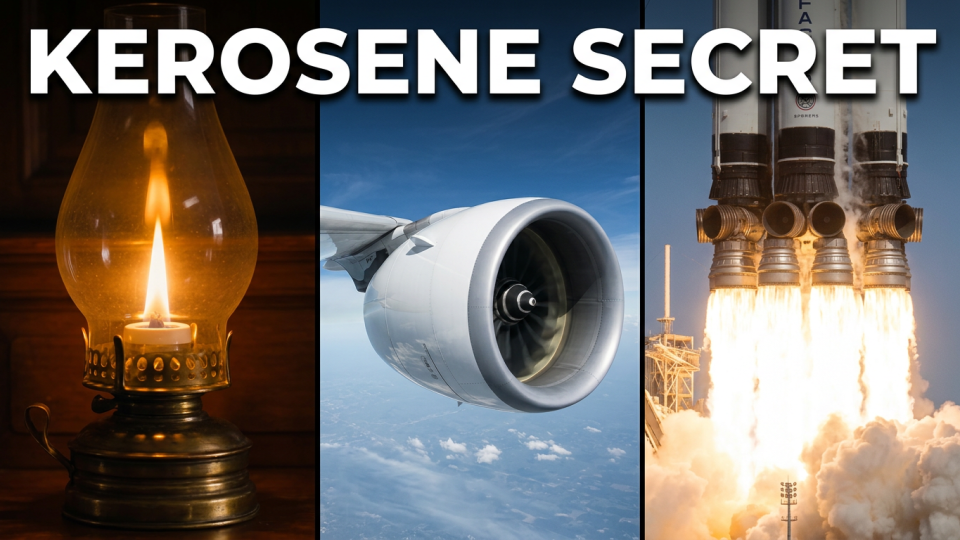
The Secret Science of Kerosene | From Oil Lamps to Rocket Engines
What do a 19th-century oil lamp, a Boeing 747 at 40,000 feet, and a SpaceX Falcon 9 rocket have in common? They all run on kerosene. The lamp that helped save the whales. The fuel carrying 4 billion passengers a year. The propellant that took humans to the Moon. One liquid. One hundred and eighty years of history. This is the complete scientific story of kerosene — from the distillation column that separates it from crude oil, to the molecular engineering that keeps it liquid at minus 47 degrees Celsius, to the rocket-grade purity required for reusable boosters, to the sustainable version being made from waste cooking oil and captured CO₂.
The complete story:
From crude oil to kerosene — the distillation column: Crude oil is not one thing — it is a mixture of hundreds of different hydrocarbon molecules all boiling at different temperatures. Think of a distillation column as a 60-meter lift shaft where heat sends each molecule to the floor where it belongs. Kerosene is the middle distillate; its molecules contain 10 to 16 carbon atoms, sitting between lighter gasoline above and heavier diesel below. Not all crude oil yields enough kerosene from distillation alone. Refineries also use hydrocracking- a molecular sledgehammer that breaks heavier molecules apart under high pressure and hydrogen to create more kerosene-range product.
The chemical car wash, hydrotreating: Raw kerosene from the distillation column contains sulfur compounds and nitrogen impurities that would destroy jet engines. Hydrotreating runs hydrogen through the kerosene at high temperature to strip out the unwanted compounds — a chemical car wash for the fuel. Aviation-grade kerosene must then pass more than 50 separate specification tests. It is filtered to remove particles larger than 5 microns, smaller than a human red blood cell. Jet fuel is not lamp oil. It is one of the most precisely specified liquids on Earth.
The Goldilocks fuel: Kerosene occupies the perfect zone between too volatile and too heavy. Its flash point of 38 to 72 degrees Celsius makes it far safer to handle than gasoline — which ignites at minus 43 degrees. Yet it releases around 43 megajoules of energy per kilogram — enough to power a jet engine efficiently across an ocean. At 40,000 feet, the outside temperature reaches minus 56 degrees Celsius. Jet A-1’s freeze point of minus 47 degrees means it stays liquid and pumpable throughout even the longest polar route. Gasoline would freeze. Diesel would gel. Kerosene flies.
Jet A-1: aviation’s global standard: A Boeing 777 carries up to 145,000 litres of fuel — roughly 580 bathtubs. Its engines consume over 10,000 litres per hour at cruise. Before that fuel touches the aircraft it has passed 50-plus specification tests, been filtered to remove particles smaller than a red blood cell, tested for thermal stability, electrical conductivity, and fungal resistance. Every airport fuel farm, every pipeline, every hydrant pit is part of a precision supply chain delivering one of the world’s most controlled liquids to aircraft engines that will spin at thousands of RPM for 12 hours without interruption.
RP-1: kerosene at its absolute limit: RP-1 (Rocket Propellant-1) is kerosene refined to extreme purity. SpaceX’s Falcon 9 burns RP-1 with liquid oxygen in nine Merlin engines simultaneously. The Saturn V — which took humans to the Moon — consumed 2,230 gallons of RP-1 every second during its first-stage burn. RP-1 must contain less than 30 parts per million of sulfur — ten times more restrictive than aviation fuel. Its key engineering challenge is coking: carbon deposits forming like soot inside turbopumps and injectors at extreme combustion temperatures. For reusable rockets like Falcon 9, post-flight inspection and cleaning of coking is an essential part of the turnaround process.
The history: how kerosene helped save the whales: In 1846, a Canadian physician named Abraham Gesner distilled a clean, bright-burning illuminating oil from coal and bitumen. He called it kerosene, from the Greek for wax oil. Before kerosene, the world burned whale oil in its lamps. By the 1850s, demand for whale oil was driving some species toward extinction. Kerosene arrived cheaper, cleaner, and available in unlimited quantities from the ground. The great whale hunting industry collapsed. Historians credit kerosene with saving the great whales from commercial extinction. A fuel changed the fate of a species.
The scale of aviation’s kerosene appetite: Global aviation consumed approximately 107 billion gallons of jet fuel in 2024 — producing 1.24 billion tonnes of CO₂ — roughly 2 to 3 percent of all global carbon emissions. Replacing this with batteries is not currently feasible. Kerosene stores 43 megajoules per kilogram. The best lithium-ion batteries store around 0.7 megajoules per kilogram. Batteries for a long-haul 777 would be 60 to 70 times heavier than the fuel they replace. The energy density of liquid hydrocarbon fuel is one of the most difficult physical properties in all of energy to replicate.
Sustainable Aviation Fuel, the next kerosene: SAF is chemically almost identical to conventional jet fuel. The aircraft does not know the difference. The engine does not know the difference. The atmosphere does — because SAF reduces lifecycle CO₂ emissions by up to 80 percent. SAF can be made from waste cooking oil through the HEFA process, from agricultural residues and municipal waste through Fischer-Tropsch synthesis, or from captured CO₂ and green hydrogen through power-to-liquid pathways. In 2025, SAF production reached 1.9 million tonnes, just 0.6 percent of global jet fuel demand. The SAF market was worth $1.7 billion in 2024 and is projected to reach $212 billion by 2034 at a compound growth rate of approximately 54 percent per year.
