Paper Title: A new hash function based on irreversible finite automata
Authors: Ghassan Salloom, Layth Hassnawi, Karam Mohammed, Mohammed Adhab
Corresponding Author: Ghassan Salloom (ghassankhaleel@gmail.com)/Iraq
Abstract
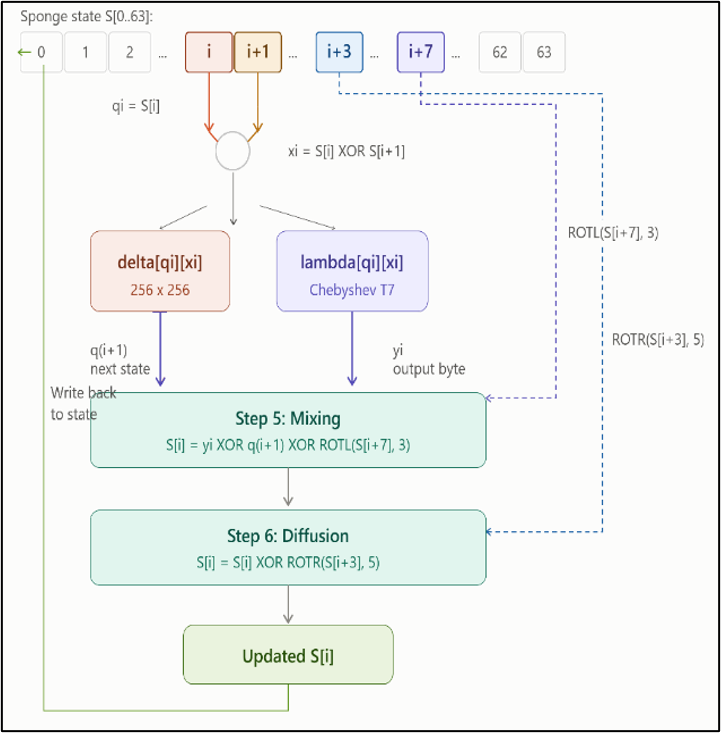
A mathematical hash function maps inputs of arbitrary length to unique outputs (digests) of a fixed length. It is highly useful and used in almost all information security applications; it can also serve as index data in hash tables, detect duplicate data for fingerprinting or uniquely identifying files, and serve as well for checksums to identify data corruption. In this work, a novel 256-bit cryptographic hash function based on the irreversible Mealy finite automata model (IFA) is introduced. In this architecture, the irreversible transition matrix of the Mealy automaton (IFA) is constructed using a non-injective state-transition mechanism to introduce local irreversibility and ambiguous backward reconstruction. The automaton output table is precomputed using a Chebyshev-based nonlinear generator to improve output randomness and nonlinear complexity. For further diffusion, confusion, collision resistance, and one-wayness improvements, we integrate the irreversible automaton within a sponge-based construction with a 512-bit internal state (256-bit rate + 256-bit capacity), yielding a designed collision resistance of bits and preimage resistance of under the sponge capacity bound. Evaluation against SHA-256 shows an avalanche mean of 50.02% (σ = 3.14%), all 13 NIST SP 800-22 statistical tests passed, and zero collisions among 50,000 tests. Throughput is about 13 MB/s versus 183 MB/s for SHA-256, reflecting the sequential dependency of the Mealy transformation.
