Paper Title: XLeaf-Net: an explainable deep learning framework for mango leaf disease classification and severity assessment using Grad-CAM-based visual interpretation
Authors: Shweta Amar Satao, Swati R. Maurya
Corresponding Author: Shweta Amar Satao (shweta.satao@somaiya.edu)/India
Abstract
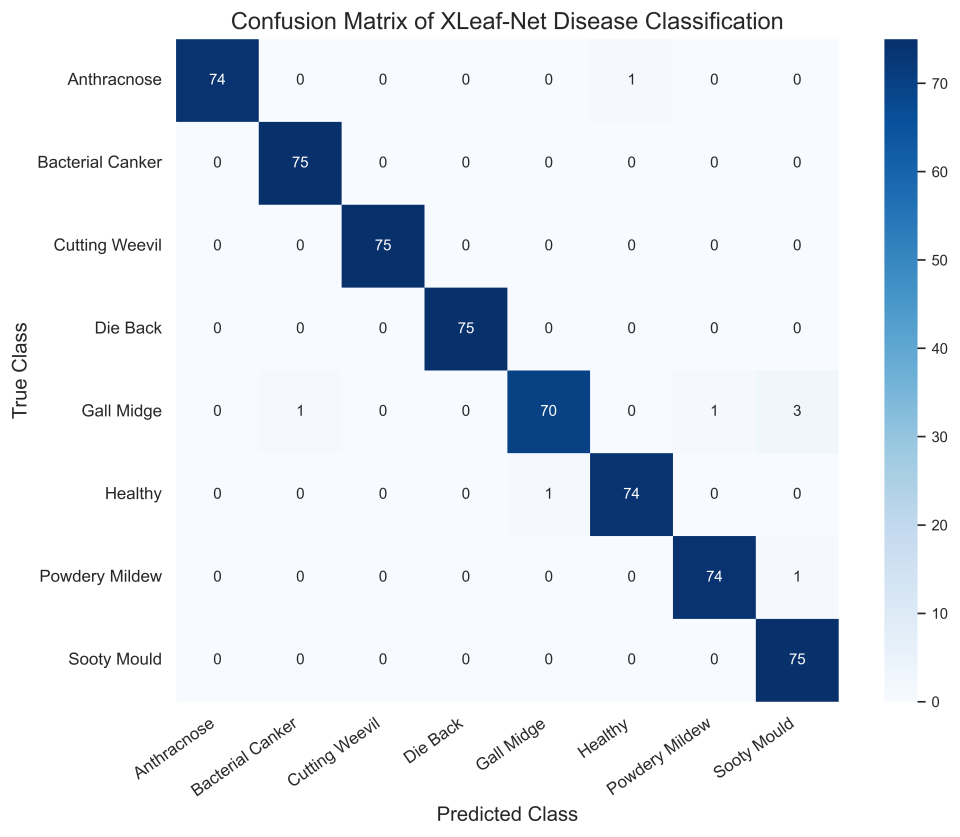
Accurate mango leaf disease recognition is important for automated crop-health assessment, but reliable evaluation requires transparent data partitioning, appropriate baseline comparison, and cautious interpretation of severity and explainability outputs. This study presents XLeaf-Net, an explainable deep-learning framework for mango leaf condition classification, image-derived severity assessment, and Grad-CAM-based visual interpretation. Experiments were conducted on the balanced MangoLeafBD dataset using an image-level stratified train-validation-test protocol with file-level integrity and capture/session-group overlap checks. XLeaf-Net was trained from scratch and compared with from-scratch VGG16, ResNet50, and EfficientNetB0 models under the implemented model-specific training configurations. An auxiliary severity model used conservative, image-derived symptom-intensity proxy labels, while Grad-CAM was applied to qualitatively examine class-discriminative regions. XLeaf-Net achieved 98.67% image-level test accuracy and a 98.66% macro F1-score, outperforming the evaluated from-scratch baselines while using 2.52 million parameters. The severity model achieved 78.17% accuracy and an 80.89% macro F1-score. Grad-CAM visualizations frequently overlapped with visually symptomatic leaf regions in representative correctly classified images. These findings demonstrate strong image-level performance within the implemented protocol; however, severity labels were not expert-annotated, and the evaluation was not session-independent. XLeaf-Net should therefore be considered a compact candidate framework requiring further independent validation.
