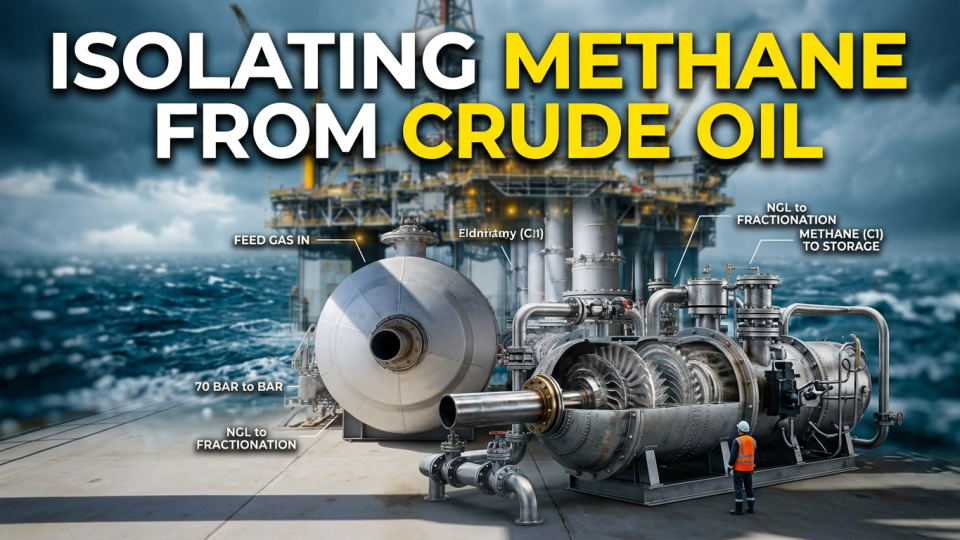
Cryogenic Natural Gas Fractionation | How Offshore Platforms Isolate Methane From Crude Oil
When an offshore platform taps a reservoir a mile below the seabed, it doesn’t find gas. It finds a chaotic, high-pressure cocktail of oil, gas, water, and sand all mixed together at up to 450 PSI. That mixture is useless and dangerous. Before a single molecule of methane can enter a pipeline, it must be sorted, cleaned, and cooled to -100 degrees Celsius, colder than Antarctica in winter, on a floating steel platform battered by salt spray and 15-meter waves.
The cooling machine uses no refrigerator. It uses the gas’s own pressure, exactly like a CO₂ fire extinguisher gets icy when you press the trigger. A precision turbine called a turbo-expander takes in high-pressure gas on one side and releases cold, low-pressure gas from the other. Then a vertical sorting machine 30 meters tall, hot at the bottom, cold at the top, sorts the remaining gases by weight, letting each one settle at its own level.
The result: pure methane into the pipeline, and three separate billion-dollar products onto tankers. The global market for these recovered gases was $23.46 billion in 2025. And every plastic bag, every water bottle, every car bumper — starts as ethane recovered by this process.
The complete story:
🌊 The cocktail problem: Raw wellhead fluid is a pressurized mix of oil, gas, water, and sand arriving from a mile below the seabed at up to 450 PSI. It cannot enter a pipeline in this form. Gas and water under pressure form solid ice-like crystals called hydrates that block pipelines completely. The platform must separate every component before anything leaves.
Stage 1 — Three-phase separation: The first stage works exactly like a snow globe settling when you put it down. The heaviest sinks to the bottom — water. Oil floats in the middle. Gas rises to the top. Large horizontal tanks give the mixture time and space to separate itself by weight.
Stage 2 — The fire extinguisher trick: The gas rising from the separator still contains heavier cousins — ethane, propane, and butane — mixed with the methane. To separate them, the gas must be cooled dramatically. But there is no external refrigerator. Instead, a machine called a turbo-expander — think of it as a jet engine running in reverse — drops the gas pressure rapidly. For every bar of pressure drop, the temperature falls by around 1.5 degrees Celsius. A pressure drop of 65 bar cools the gas by nearly 100 degrees. The nozzle of a CO₂ fire extinguisher gets icy for exactly the same reason.
Stage 3 — The fractionation column: At -85 to -100 degrees Celsius, propane and butane can no longer stay as gas — exactly the way breath condenses on a cold window, they drop out as liquid. This mixed liquid feeds a fractionation column — a vertical sorting machine, 30 meters tall, hot at the bottom and cold at the top. Each gas finds the temperature where it wants to be and settles there. Methane exits at the very top. Ethane, propane, and butane exit at different heights below, each collected as a separate product stream.
The money: Pipeline operators check methane purity at the connection point every few minutes. Their minimum requirement: 95% pure methane. Below that, the valve closes. The entire platform’s gas output is rejected. Miss the purity target and the platform loses its primary revenue. Miss the NGLs — ethane, propane, butane — and it loses its secondary revenue. The global NGL market was worth $23.46 billion in 2025, growing to $36.83 billion by 2033. ExxonMobil invested $500 million to expand NGL capacity in 2024–2025. Chevron invested $1 billion in NGL infrastructure in 2025.
The everyday connection: Ethane recovered from offshore fractionation feeds ethylene plants — the global ethylene market was worth over $100 billion in 2025. Every plastic bag, water bottle, car bumper, and food package in your home starts as ethane from a process like this. Propane fills the barbecue bottle in your garden. The supply chain from ocean floor to everyday object runs through the turbo-expander.
The offshore challenge: The cryogenic pipes operate at -100°C while the ambient deck temperature in tropical offshore locations can be +35°C — a difference of 135 degrees across a few meters of insulation. Contact with the pipes would cause instant freeze burns. Salt spray attacks the insulation continuously. If moisture seeps into the insulation and freezes, it expands and cracks the insulation from the inside. Repair cost for one failure on an offshore platform: easily $1 million. The fractionation column must also keep working during storms; platforms can tilt 5 degrees in heavy weather, which mixes the liquid layers and causes separation to fail.
The energy recycling trick: The turbo-expander’s spinning shaft connects directly to a compressor on the other end — like two fans back to back on the same axle. The energy extracted from the cooling gas immediately powers the methane recompression for export. The machine cools the gas and compresses the product simultaneously, saving the platform millions in electricity costs.
The improvement: Twenty years ago, turbo-expander technology recovered around 50% of available ethane. Today, new designs recover up to 95%. Automated monitoring has cut plant downtime by 30% — critical on a platform costing over $1 million per day to operate.
