Paper Title: Design and fabrication of an efficient solar powered desalination system for remote communities
Authors: Sujesh Kumar, G.C. Prabhakar, Sandhyarani Mahalik, Sandeep Kumar Sahoo, Prashant Kharote, Abdul Khadar Asundi, Mohammed Hameeduddin Haqqani
Corresponding Author: Sujesh Kumar (sujesh@mite.ac.in)/India
Abstract
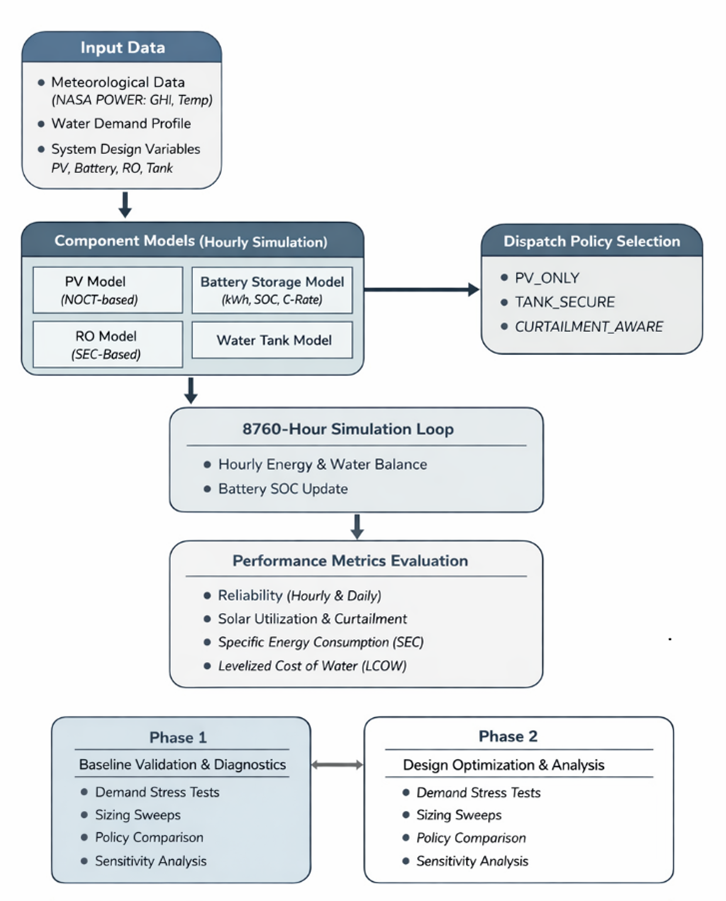
Solar desalination is a viable solution to freshwater scarcity in remote, off-grid communities without centralized infrastructure. In this work, the design, performance, and evaluation of an autonomous photovoltaic (PV)-battery-reverse osmosis (RO)-water tank desalination system are presented using simulation. The system is modeled in MATLAB software at an hourly resolution for one complete year (8760h) with realistic climatic data from the POWER (Power System Energy) database at the National Aeronautics and Space Administration. Physically consistent models are applied to PV generation, battery energy-power behavior, RO-specific energy consumption, and freshwater storage dynamics. Baseline results indicate that a community demand of 10 m3/day can be met with 98.63% daily reliability, resulting in 3643.73 m3/year of desalinated water and 0.319% unmet demand, with a realized SEC of 4.74 kWh/m3. However, only 56.43% of the available PV-bus energy is utilized, indicating considerable PV curtailment. The outcome of phase 2 indicates that a decrease in the levelized cost of water (LCOW) through relaxing reliability to 95% daily, without compromising acceptable service levels, is possible. Demand sensitivity, design space exploration, and dispatch policy comparison reveal the great potential of curtailment-aware operation, in conjunction with sufficient water storage, to enhance system efficiency and economic performance in remote desalination applications.
Keywords
Solar-powered desalination, Off-grid systems, Reverse osmosis, Renewable energy integration
Cite:
Kumar, S. ., Prabhakar, G., Mahalik, S. ., Sahoo, S. K. ., Kharote, P. ., Asundi, A. K. ., & Haqqani, M. H. . (2026). Design and fabrication of an efficient solar powered desalination system for remote communities. Future Technology, 5(3), 57–68. Retrieved from https://fupubco.com/futech/article/view/785
