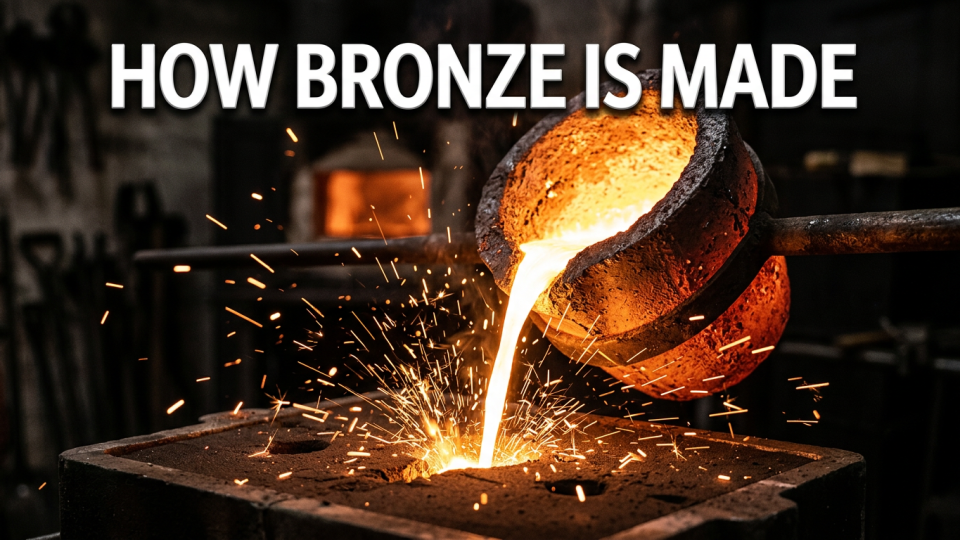
How Bronze Is Made | The 5,300-Year-Old Alloy That Modern Engineering Cannot Replace
A single ship propeller can weigh 130 tonnes, spin at 120 RPM continuously for 25 years submerged in seawater, and be machined to 0.1mm tolerance. The alloy that makes this possible was invented in 3300 BCE. No modern polymer, ceramic, or composite has replaced it – because the combination of properties is genuinely unique. Bronze is not one material. It is a family of copper-based alloys worth over $10 billion annually in 2025. Four distinct alloy families. Each doing something no other material can replicate.
The complete engineering story:
The chemistry – why bronze is strong: When tin dissolves into molten copper, tin atoms occupy interstitial positions inside copper’s face-centered cubic crystal lattice. This atomic infiltration distorts the lattice, preventing dislocation movement — the mechanism that causes plastic deformation. The result: a metal that is simultaneously stronger, harder, and more wear-resistant than either parent metal. The eutectic point sits at 13.5% tin — the composition where bronze becomes easiest to cast. Below this: tougher and more ductile. Above: harder and more brittle. Every bronze engineer navigates this curve, tuning tin content to target specific performance.
The modern foundry process:
- Induction melting: Copper (melting point 1,085°C) is loaded into an induction furnace. The electromagnetic coil generates eddy currents inside the copper charge, heating the metal from within with no flame, no combustion, pure electrical energy at a precisely controlled temperature.
- Alloying: Once molten, tin is added in precise quantities. For phosphor bronze, 0.1% phosphorus is added as a deoxidizer, removing dissolved oxygen that would create porosity while remaining in the alloy to boost wear resistance by 40%.
- Degassing: Liquid bronze dissolves hydrogen from atmospheric moisture. As it solidifies, the hydrogen escapes as gas bubbles, creating microscopic porosity that halves fatigue strength. Nitrogen is bubbled through the melt via a lance, flushing hydrogen to the surface. The difference between a porous casting and a sound one is visible in cross-section — and the difference in fatigue strength is 50%.
- Casting: Sand casting pours molten bronze into a packed sand mould – flexible, handles complex geometries, cost-effective for valves, sculptures, and propeller blades. Centrifugal casting spins the mould at up to 1,000 RPM – centrifugal force drives dense metal outward and impurities inward, producing perfectly sound tubes, bearings, and bushings.
Marine applications — why aluminum bronze is irreplaceable: An ultra-large container vessel propeller (C63200 nickel aluminum bronze) spans 9.6 meters in diameter, weighs 130 tonnes, and operates at 120 RPM in seawater for 25 years. Aluminum bronze achieves this because aluminum forms a self-healing alumina oxide film on the surface — identical in principle to titanium’s passivation layer. But unlike stainless steel, aluminum bronze also resists cavitation: the explosive collapse of micro-bubbles that generates up to 400 MPa local pressure on impact. Stainless steel pits and erodes under cavitation. Aluminum bronze self-heals.
Bearings and anti-seizing: When a steel shaft rotates inside a bronze bushing, the two metals never cold-weld under load – the phenomenon called galling that destroys steel-on-steel interfaces. Bronze transfers a microscopic film of material to the shaft surface, creating a self-lubricating interface that wears slowly and predictably. Steel-on-steel under the same conditions seizes catastrophically.
Phosphor bronze – in every device you own: The spring contacts in every USB port, SIM card tray, and PCB connector are phosphor bronze. The 0.1% phosphorus addition creates a fatigue life of 100 million flex cycles without failure, while maintaining 60% of pure copper’s electrical conductivity. The spring is typically 0.1mm thick.
Silicon bronze – sculpture and architecture: Silicon bronze (2-4% silicon) is the only bronze alloy that can be arc-welded cleanly. The Statue of Liberty is silicon bronze. It develops a natural patina progression — gold → dark oxide → red cuprite → green copper carbonate — that forms an impermeable barrier preventing further corrosion for centuries.
Phosphor bronze guitar strings: Acoustic guitar strings use phosphor bronze winding because its stiffness-to-mass ratio produces the precise harmonic overtone series that human ears perceive as warm, full, and natural. Replace with plain steel: harsh. Replace with nylon: muted.
The green energy connection: Every offshore wind turbine uses aluminum bronze pitch control bearings, yaw bearings, and main shaft bearings — running under cyclic fatigue loads in saltwater spray environments for 20 years without maintenance access. Tidal energy turbines operate fully submerged. Desalination plants serving 300 million people use aluminum bronze pump impellers that run continuously for 15+ years — compared to 2–3 years for stainless steel 316 in the same application.
Aerospace bronze: Nickel-aluminum bronze grades C63000 and C63200 achieve a tensile strength of 862 MPa – stronger than medium carbon steel at 690 MPa – while passing 500-hour salt spray tests that destroy steel at 100 hours. Used in Airbus A380 landing gear bushings, Boeing 787 actuator components, and military aircraft hydraulic systems.
The future – green hydrogen: New modified copper-nickel-bronze alloys are being developed for green hydrogen electrolyzer applications. Hydrogen embrittlement — the infiltration of hydrogen atoms into metal lattices causing catastrophic cracking — is the critical failure mode. Modified bronze lattice structures are among the leading material candidates for the projected $130 billion green hydrogen market by 2050.
