Paper Title: A fragile reversible watermarking technique for medical imaging security using prediction error expansion and Canny edge detection
Authors: Asaad F. Qasim, Ahmed Hussain Ali
Corresponding Author: Asaad F. Qasim (asaad.flayyih@mohesr.edu.iq)/Iraq
Abstract
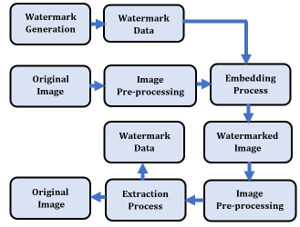
This paper develops a fragile, reversible watermarking technique to detect accidental and intentional alterations in DICOM medical images. A fragile method is adopted to detect any manipulation applied to medical images, while reversibility ensures the recovery of the original unaltered image at extraction. The proposed approach automatically segments medical images into Region of Interest (ROI) and Region of Non-Interest (RONI), extracts authentication data from the DICOM header, and generates a digital signature of the image. The method combines integrity and authentication data and inserts them into the edge areas within the ROI, implementing the Prediction Error Expansion (PEE) technique and Canny edge detection. During extraction, the embedded watermark and the original unmanipulated image are restored without knowing the pixel locations used to hide the watermark data. The method was assessed using twelve 16-bit DICOM images, including MRI and CT, with a 512×512 pixel size. The experimental results yielded an average PSNR of 97.19 dB and an average SSIM of 0.999996, with an average watermark length of 7835 bits per image. The proposed method also fully met the reversibility requirement by recovering both the original unaltered images and the embedded watermark data. Fragility evaluation showed that manipulations of watermarked images can be detected via alterations in the retrieved watermark. The achieved results demonstrate the effectiveness of the proposed technique in maintaining visual image quality while ensuring reversibility, integrity, and authenticity in the conducted experiments.
