Paper Title: Oil, labor, and the fraying social contract: a review of energy justice and future energy transition in Trinidad and Tobago
Author: Randy Ramadhar Singh
Corresponding Author: Randy Ramadhar Singh (randyr007@gmail.com)/ Trinidad and Tobago
Abstract
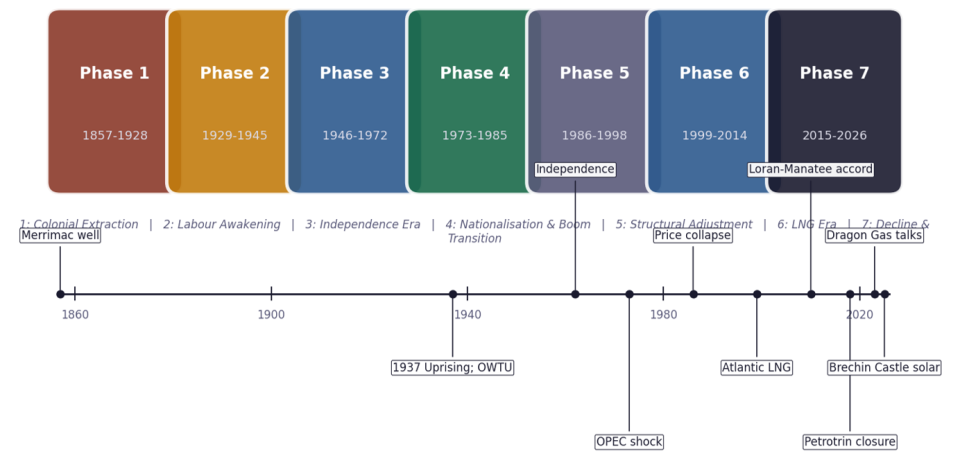
This review explores the history of Trinidad and Tobago’s hydrocarbon sector through the lens of energy justice. The unresolved issue in Trinidad and Tobago, as in many petro states, is achieving a democratic transition that genuinely includes affected people. Energy justice is the starting point for sustainable transition. It considers future energy systems, decarbonization, and sustainable policies. Drawing on peer-reviewed literature, government archives, and comparative studies with other nations, the review covers 169 years of oil and gas, from the first drilled Merrimac well in 1857 to current plans for cross-border gas cooperation with Venezuela and a 30% renewable-energy electricity target by 2030. Adopting a three-level energy justice approach of distributional, procedural, and recognition justice, the paper analyses four events: the 1937 labor unrest, OWTU campaigns (1960-1985), the Alutrint case, and the Petrotrin refinery closure in 2018. The study finds a degradation of the extractive social contract: a weaker state-citizen relationship driven by rent-based governance rather than democratic accountability. Unlike Norway, Nigeria, Venezuela, Alaska, and Scotland, Trinidad and Tobago is characterized by procedural and recognition justice problems of distressed petro-states rather than transition countries. This paper proposes a new social contract model that emphasizes participatory energy governance, transparent benefit distribution, planning for a just transition and energy democracy, and a path to decarbonization through 2065. In accordance with PRISMA 2020, the paper employs the Scopus, Web of Science, JSTOR, Google Scholar, and UWI Library Repository databases, analyzing 61 documents out of 1256. The key innovation lies in combining historical political economy with future-oriented policy, connecting energy justice diagnostics to practical institutional reforms, and overcoming political economy obstacles that have prevented reforms in Trinidad and Tobago.
