Paper Title: Petrochemical export taxation as energy-industrial policy in Iran: a product-specific value-chain analysis
Authors: Amirali Saifoddin, Afshin Gholamalipour, Mohammadali Allahrabbi Shirazi
Corresponding Author: Amirali Saifoddin (saifoddin@ut.ac.ir)/ Iran
Abstract
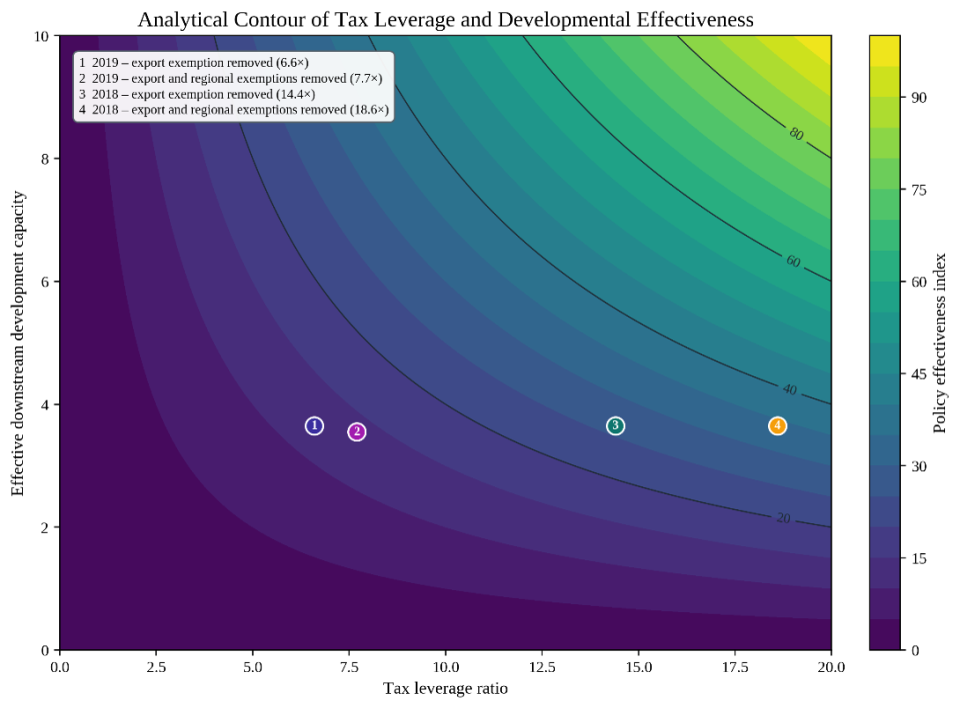
As a hydrocarbon-rich economy, Iran faces an energy-policy challenge in deciding whether to export oil and gas feedstocks as basic petrochemical products or convert them into higher-value materials. Iran’s petrochemical exports remain concentrated in basic and intermediate products, while downstream exports are limited. Using a descriptive-analytical design, documentary analysis, financial scenario analysis, and a comparative policy case study, this article examines the evolution of Iran’s petrochemical tax and export-duty policy from 2021 to 2025. The findings show that the initial approach sought to reduce the attractiveness of exporting basic and intermediate products by removing tax exemptions or imposing export duties. Evidence from the quantitative analysis reveals a structural imbalance between export volumes of raw materials (US$11.24 billion) and upstream and intermediate petrochemicals (US$11.43 billion) and the exports of downstream industry, which stood at US$0.36 billion in 2018. Import volumes of downstream industry were about US$0.56 billion and thus exceeded its export volumes. Policy projections for the modified tariff system generated about US$200 million in revenue. Taxes and tariffs can only support value chain upgrading if there is downstream capacity, comparative advantage, market demand, technological capability, and justifiable economies of scale. A comparative assessment of urea, methanol, and polyethylene shows that a one-size-fits-all policy is not appropriate for all these products. Overall, urea was eliminated, methanol was encouraged, and polyethylene needs support. The study concludes that export duty policy should move towards a more precise, product-oriented, and value chain-based regulation.
