The Green Ammonia Gambling for Global Shipping
Right now, 100,000 ships are crossing the world’s oceans carrying 80 percent of everything you own, eat, and use. Almost all of them run on bunker fuel — the thick black sludge left over after crude oil is refined. Shipping produces more CO₂ than Germany. And 98 percent of the fleet has changed nothing.
Engineers tried batteries. A pack large enough to cross the Pacific would weigh more than the ship. They tried liquid hydrogen. It requires storage at minus 253 degrees Celsius — colder than outer space. Neither works at sea.
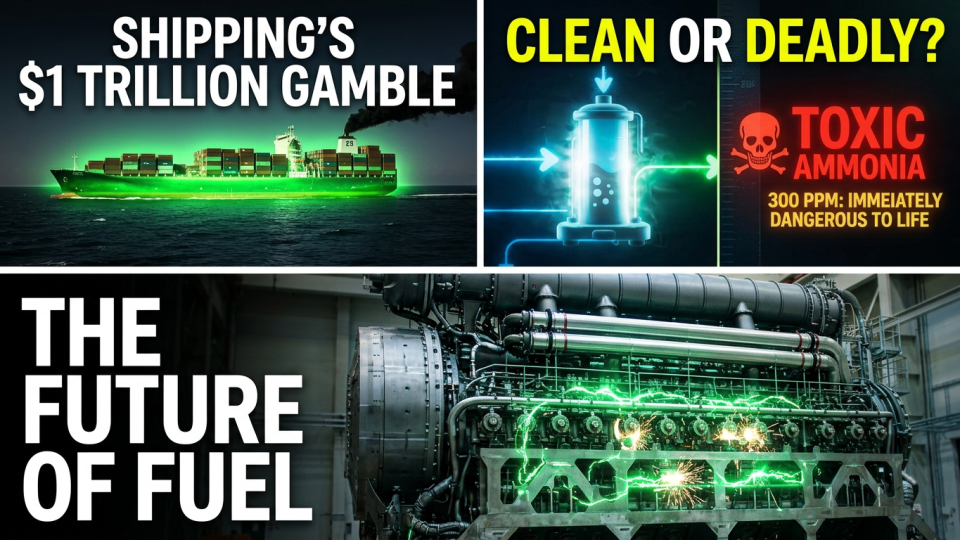
The unexpected answer is ammonia — NH₃. It contains 17.6 percent hydrogen by mass, liquefies at minus 33 degrees Celsius, and the world already produces 180 million tonnes of it every year. The infrastructure exists. The chemistry is proven. In early 2025, MAN Energy Solutions ran the world’s first full-scale two-stroke marine engine on ammonia at 100 percent load. In April 2025, the Port of Rotterdam completed an 800 cubic meter ship-to-ship ammonia transfer in 2.5 hours. WinGD delivered its first commercial ammonia engines mid-2025.
But ammonia kills you at 300 parts per million. It produces nitrous oxide when burned — itself a greenhouse gas. Every crew member on every ammonia-powered ship needs specialist training that doesn’t yet exist at scale. And green ammonia costs three to four times more than bunker fuel today, with price parity not projected until 2030 to 2035 — if carbon pricing is implemented.
Green ammonia is not a perfect solution. It is the least-bad option for an industry with no good options. The gamble is whether the price falls fast enough, the safety systems prove reliable enough, and the regulatory deadlines arrive soon enough to force the change.
