Paper Title: Value co-creation in smart transportation new infrastructure projects: the mechanism of AI-enhanced corporate culture and advertising on strategic niche construction for Shandong SMEs
Authors: Hui Yan, Rozaini Binti Rosli
Corresponding Author: Rozaini Binti Rosli (rozaini@lincoln.edu.my)/Malaysia
Abstract
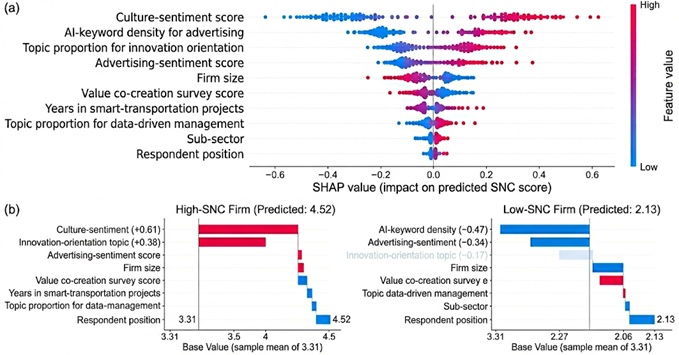
Small and medium-sized enterprises (SMEs) in China’s smart-transportation new-infrastructure sector face persistent difficulties in constructing durable strategic niches, yet existing research relies on survey-based methods that overlook the textual signals firms produce through public-facing documents. This study proposes a three-stage analytical framework that integrates NLP feature extraction, machine-learning prediction, and PLS-SEM mediation testing. Drawing on 323 SMEs in Shandong Province and a corpus of 12,864 enterprise text segments, the NLP pipeline extracts culture-sentiment, advertising-sentiment, topic-proportion, and AI-keyword-density features through BERT-wwm-ext, LDA, and TF-IDF. XGBoost achieves the best prediction of strategic niche construction (R² = 0.63), and SHAP analysis identifies culture-sentiment as the top-ranked feature (mean |SHAP| = 0.42), outperforming all survey-derived variables. PLS-SEM validates that value co-creation partially mediates both paths from AI-enhanced organizational capabilities to niche construction (VAF = 29.3% and 31.7%). The findings indicate that text-derived indicators capture strategic positioning signals that conventional questionnaires miss, offering a replicable mixed-methods paradigm for AI-management crossover research.
Keywords
NLP text mining, Machine learning prediction, Value co-creation, Strategic niche construction, Smart transportation infrastructure
Cite:
Hui Yan, Rozaini Binti Rosli (2026). Value co-creation in smart transportation new infrastructure projects: the mechanism of AI-enhanced corporate culture and advertising on strategic niche construction for Shandong SMEs . Future Digital Technologies and Artificial Intelligence, 2(1), 23–28. Retrieved from https://fupubco.com/fdtai/article/view/945
