Paper Title: Machine learning-driven pay gap analysis: predicting corporate innovation performance using XGBoost and SHAP interpretability
Authors: Qunyu Zhao, Dayao Zhou
Corresponding Author: Qunyu Zhao (leodaley2333@163.com)/China
Abstract
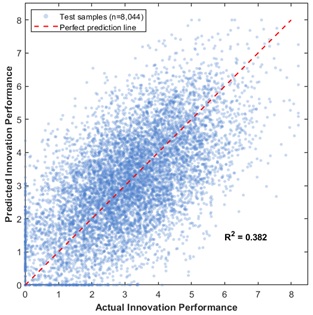
The relationship between pay gap and corporate innovation has been the focus of significant theoretical discussion, with tournament theory and social comparison theory generating contrasting predictions. Traditional linear methods are ill-suited to capturing the nonlinear nature of the relationship. This study proposes an XGBoost-SHAP approach to predict innovation performance using a sample of 26,815 firm-year observations from Chinese A-share-listed firms from 2010 to 2023. The results show that the XGBoost model achieves an R2 of 0.382, which is 65.4% higher than OLS (R2=0.231). The SHAP value analysis indicates that the vertical pay gap ranks as the third most important factor, following firm size and firm age. The SHAP dependence plot shows an inverted U-shaped relationship between the vertical pay gap and innovation performance, with a turning point at approximately 8.7 times. The heterogeneity analysis indicates that state-owned enterprises attain their turning point earlier (7.2 times) than non-state-owned enterprises (10.1 times), suggesting that employees are more responsive to pay inequality. These findings provide practical insights that may guide managers in designing their firms’ compensation schemes. Firms that fall below the threshold may consider expanding their pay gaps, while those that fall above may consider compressing their pay gaps. This XGBoost-SHAP approach translates statistical evidence into practical diagnostic tools that managers may use to assess the optimality of their firms’ compensation schemes in supporting innovation.
Keywords
Pay gap, Innovation performance, XGBoost, SHAP, Tournament theory, Social comparison theory
Cite:
Zhao, Q., & Zhou, D. (2026). Machine learning-driven pay gap analysis: predicting corporate innovation performance using XGBoost and SHAP interpretability . Future Technology, 5(2), 255–267. Retrieved from https://fupubco.com/futech/article/view/841
