Paper Title: AI-driven digital transformation: a framework for organizational capability assessment and strategic decision-making in technology management
Authors: Wei Li, Hj Sukesi, Bambang Raditya Purnomo
Corresponding Author: Wei Li (18519383413@163.com )/Indonesia
Abstract
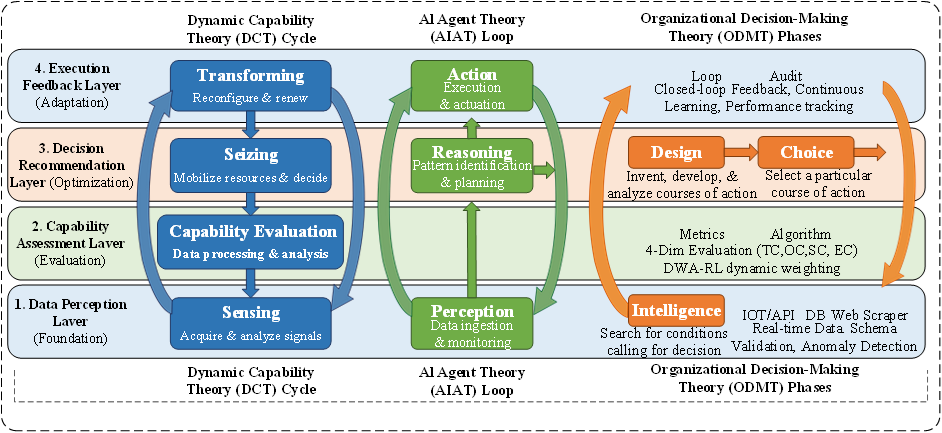
This study develops an Agentic AI-driven framework to address critical challenges in digital transformation, including subjectivity. A Dynamic Weight Adjustment algorithm, which is based on Deep Reinforcement Learning (DWA-RL), enables adaptive updating of the weights assigned to each evaluation indicator across four capability dimensions: Technology, Organizational, Strategic, and Ecosystem. The empirical validation involved over 8,000 enterprise samples from the World Bank Enterprise Surveys and case studies by MIT. For the training datasets, supplementary synthetic data has been generated by Monte Carlo simulation and Generative Adversarial Networks. The framework achieves 87.3% prediction accuracy, which is 15.8% higher than MIT CISR and 17.5% higher than McKinsey, shows the best dynamic adaptability of 4.6/5.0, and improves the quality of decisions by 28% compared to the traditional experience-based approach. Under volatile environments, the DWA-RL algorithm keeps the decline within 17.6 percentage points, while for fixed-weight methods, the decline is as high as 25.5 points. Manufacturing enterprise transformation trajectories prove balanced four-dimensional capability development over three-year periods. The current study extends dynamic capability theory by introducing mechanisms of autonomous agents and redefining the agent-dominated human-supervised decision paradigm.
Keywords
Agentic AI, Digital transformation, Dynamic capability assessment, Deep reinforcement learning, Technology management strategic decision-making
Cite:
Li, W., Sukesi, H., & Purnomo, B. R. (2026). AI-driven digital transformation: a framework for organizational capability assessment and strategic decision-making in technology management. Future Technology, 5(2), 71–81. Retrieved from https://fupubco.com/futech/article/view/694
