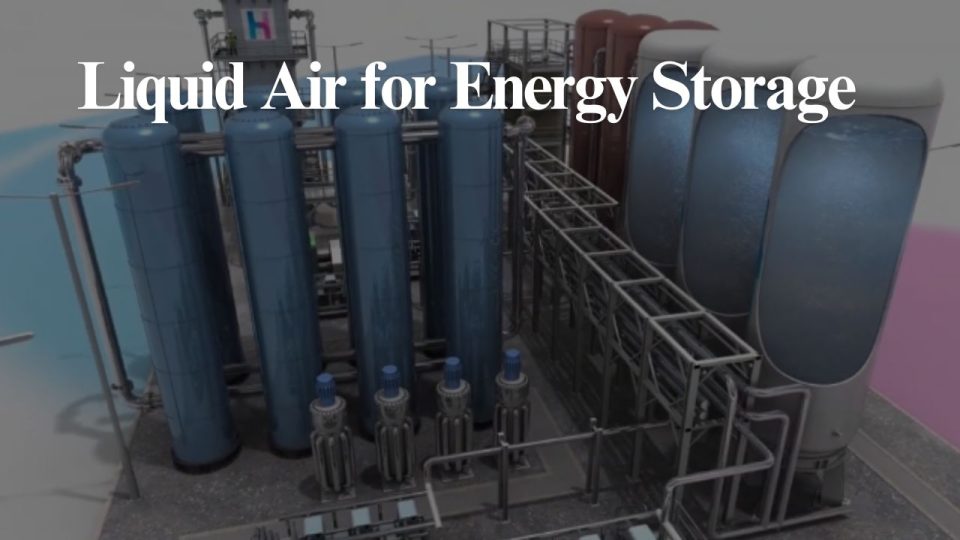
Liquid Air for Energy Storage
Liquid Air Energy Storage (LAES) is an emerging technology designed to support renewable energy systems by storing excess electricity in the form of liquid air and converting it back into power when needed. As renewable energy sources like wind and solar become major contributors to national grids, the challenge of intermittency becomes more pronounced. LAES offers a thermodynamic solution: surplus electricity is used to cool and compress atmospheric air to –196°C, transforming it into a dense liquid stored in insulated, low-pressure tanks. When power demand rises, the liquid air is reheated, rapidly expanding into gas that drives a turbine to generate electricity. LAES is gaining attention because it provides long-duration, large-scale storage—qualities that batteries often cannot deliver economically or technically. It does not degrade over time like lithium-ion batteries, uses abundant materials such as steel and air, and operates safely due to its non-toxic, non-flammable nature. Countries such as the United Kingdom have developed the first commercial LAES facilities, while the United States, China, Japan, and several European nations are advancing pilot projects. Integrating LAES with industrial systems can enhance efficiency by using waste heat to boost power output. However, LAES has challenges. Round-trip efficiency remains lower than other storage technologies, typically around 50–60%, and the infrastructure required for cryogenic systems is costly. Large amounts of renewable surplus energy are needed for operation, making geography a determining factor in viability. Despite these drawbacks, LAES is recognized as a promising solution for stabilizing grids with high renewable penetration. Its potential for long operational life, scalability, and environmental compatibility positions it as a strong contender for future clean energy strategies as nations pursue net-zero goals.
