Paper Title: Innovative approaches to software defect prediction using ensemble learning models
Authors: Prashant Kumar Tamrakar, Deepjyoti Roy, Preeti Agarwal, Mohammed Fikery Ghemas, Snigdha Madhab Ghosh, Rekha. K.S, Meenu Mohil
Corresponding Author: Prashant Kumar Tamrakar (prashant.tamrakar35@gmail.com)/ India
Abstract
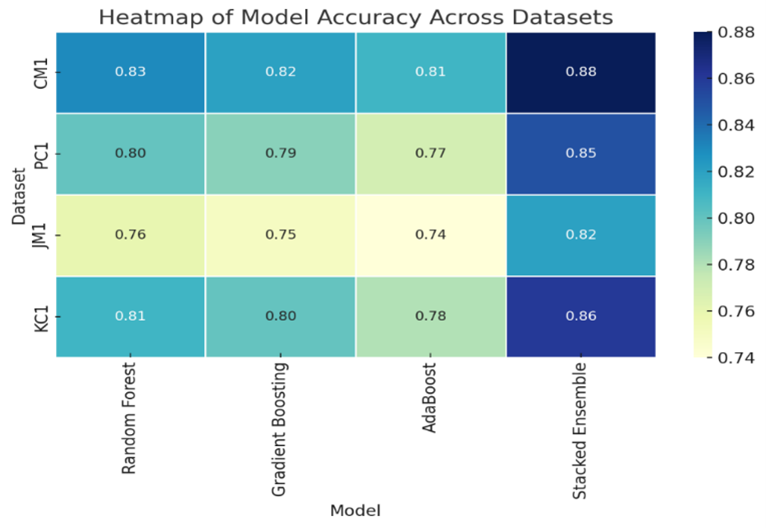
Software defect prediction (SDP) is one of the most critical aspects of software quality improvement and efficient use of testing resources. Traditional machine learning models tend to lack both generalizability and performance, especially when faced with imbalanced or small datasets. To overcome these limitations, the current research proposed a stacked ensemble learning model that combines Random Forest, Gradient Boosting, and AdaBoost as base learners, and logistic regression as a meta-learner. A selected collection of 500 software modules was sampled out of four benchmark repositories: CM1, PC1, JM1, and KC1. Stratified sampling, Min-Max normalization, SMOTE-based class balancing, feature selection via Recursive Feature Elimination (RFE), and mutual information ranking were used as preprocessing steps. The training of the models used 10-fold cross-validation, and hyperparameter optimization was done using Grid Search. The findings showed that the stacked ensemble performed better than any single classifier on all measures, with the highest accuracy of 0.88 and statistically significant improvements in precision, recall, and F1-score (p < 0.05). Data balancing and feature selection methods also increased model stability and interpretability. In summary, the suggested framework will provide a powerful, scalable, and resource-optimal system to predict software defects. This method can be replicated in future studies on larger datasets and with deep learning–based meta-models to improve adaptability. Its integration of Recursive Feature Elimination and mutual-information feature ranking within an optimized stacking design, applied to NASA repositories for the first time, demonstrates measurable improvements in generalization and robustness.
Keywords
Software defect prediction, Ensemble learning, Stacking model, Feature selection, SMOTE, Machine learning
Cite:
Tamrakar, P. K. ., Roy, D. ., Agarwal, P. ., Ghemas, M. F. ., Ghosh, S. M. ., K.S, R. ., & Mohil, M. . (2025). Innovative approaches to software defect prediction using ensemble learning models. Future Technology, 5(1), 38–46. Retrieved from https://fupubco.com/futech/article/view/532
