Biography
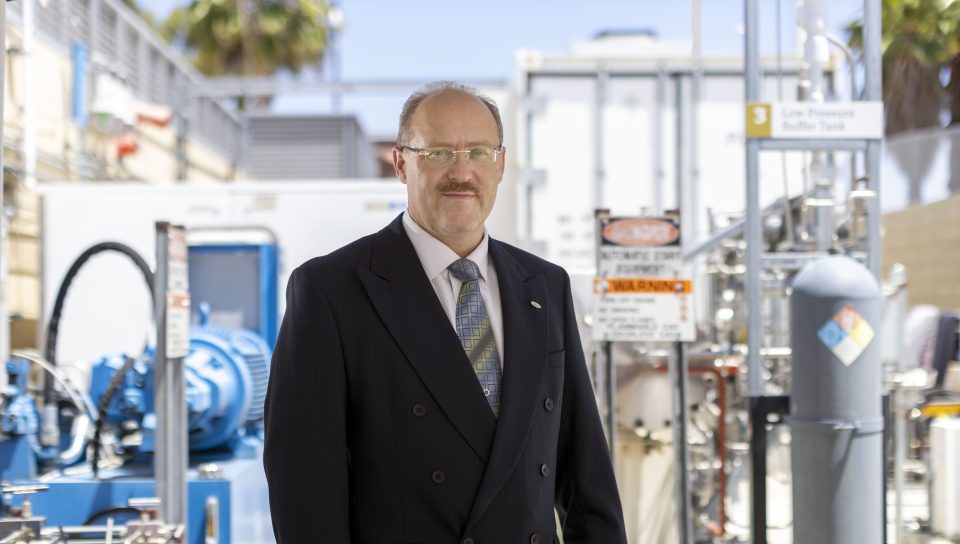
Dr. David Blekhman, a professor of Sustainable Energy and Transportation at Cal State LA, is a pioneering figure in the field. As the founding technical director of the Hydrogen Research and Fueling Facility, he leads the academic campus facility that produces hydrogen through electrolysis. He was also recognized as a 2025 Cal State LA President’s Distinguished Professor and 2023 CSU-wide Wang Family Excellence Award for Outstanding Scholarship. His expertise in hydrogen transportation has garnered international acclaim, including the prestigious 2019-20 Fulbright Distinguished Chair in Alternative Energy Technology in Sweden. Dr. Blekhman’s leadership has secured multimillion-dollar funding from organizations like NSF, DOE, DOT-FHWA and CEC for hydrogen infrastructure and advanced transportation projects. He actively shapes California’s clean energy workforce through innovative courses and student-centered research.
- Future: Green hydrogen is often mentioned as the future of clean energy. What are the current technological and economic challenges in scaling green hydrogen production using renewables?
Prof. Blekhman: Indeed, green hydrogen is viewed as the future of clean energy. Twenty–five years ago, we were thinking about hydrogen as a fuel for decarbonizing transport. But as renewable energy continued to grow, we started thinking about storing that energy — either in batteries or in green hydrogen — and then utilizing it for daily applications or seasonally, depending on the climate and local needs. The reality of clean energy is that in most situations it is intermittent. Instead of receiving continuous power, as you would from a coal, gas, or nuclear plant, solar energy only exists for a few hours during the day in a good climate. Wind is also intermittent — sometimes stronger, sometimes weaker — making it harder to plan for. In climates like Los Angeles, solar is easier to predict, and in California there are even days when we produce enough renewable energy to cover the state’s needs. However, as soon as the sun goes down, demand continues (for example, air conditioning), so batteries are strongly pursued for daily storage. Yet there are concerns about battery systems longevity. Therefore, it is feasible even in climates like California to see strong growth in green hydrogen produced via electrolysis. Unlike fossil fuels, hydrogen must be made using electricity, which in turn requires investment in wind farms and solar parks. Fossil fuels already exist in nature, but renewables demand consistent, long-term investment — which is why hydrogen remains expensive.
Fortunately, solar technologies are durable (lasting 25–30 years). For example, Cal State LA has used old solar Sharp modules, which were manufactured in 2000 used and donated, since 2011, and they continue to work well. I don’t need to touch this system. Later, a 1 MW solar system was installed in 2020, which paid for itself within 5 years and now provides around $500,000 in annual value.
Another challenge is that most solar modules are produced in China; broader global manufacturing would help spread benefits. Similarly, electrolyzers are key: alkaline electrolyzers are reliable and cost-effective, and many countries could produce them, but adoption has been slow. China already supplies many electrolyzers, while Europe and the U.S. are developing capacity. It will take time — scientists predicted in the 1980s that commercialization would take 50 years, and it still seems true if started this year. The important step now is to keep moving forward with the work.
- Future: Your team has worked with methanol reforming and electrolysis. How do you see the role of hybrid production systems—like combining multiple sources at a single station—evolving in the coming decade?
Prof. Blekhman: This question refers to operating a hydrogen station within a network of other hydrogen stations. Our experience shows that hydrogen stations can go down for a variety of reasons: sometimes due to technical challenges, sometimes due to logistical issues in hydrogen delivery. The majority of hydrogen stations in California are based on delivery model (either gaseous or liquid). By contrast, the Cal State LA hydrogen station is based on electrolysis, meaning it could be stopped only by a power outage, electrolyzer issue, water supply problem, or similar factors. For a while, we considered supplementing our hydrogen station with delivered hydrogen or having a second production source — for example, methanol reforming. We had discussions with a company called Azolla Hydrogen in Alberta, Canada. While our direct collaboration did not work out, Azolla Hydrogen continues developing reactors that can take renewable methanol and convert it into hydrogen. The concept of combining electrolysis with methanol reforming could play a significant role in improving resilience on one hand and reducing costs on the other. For example, if electricity is expensive, a station could run on methanol reforming; if electricity is cheaper, it could run the electrolyzer. In this way, multisource hydrogen stations would provide both economic flexibility and operational resilience.
- Future: Your team earned Gold in the Hydrogen Safety Challenge. What specific sensor or control systems were introduced/improved to maintain safe operation during repeated fueling cycles?
Prof. Blekhman: The most important factor in hydrogen safety is human capital. Human error is the most common source of potential risk, so thorough training of employees and establishing robust operational and maintenance practices are essential. These practices, followed consistently, form the “secret sauce” of hydrogen safety.
It is not a one-time process — it requires constant monitoring, regular refreshers of skills and knowledge, and adherence to established procedures. Through the Hydrogen Safety Challenge offered this year the Center for Hydrogen Safety and where we secured first place and Gold Medal, we had the opportunity to revisit our practices, reinforce our commitment to safety, and learn new approaches from the challenges. Additionally, the competition helped us engage with university administration to identify what institutional practices exist, and what still needs to be implemented, to ensure safety at both the hydrogen station and the broader university environment.
Maintaining hydrogen leak sensors in enclosures has been one of the most challenging factors. For larger hydrogen station tours, we have recently started to demonstrate the use of hydrogen sniffers for leak detection, using a tiny lab electrolyzer. This mimics a periodic station walk-through, checking connections that may develop leaks — especially during early operation while the station is still breaking in.
- Future: What role do you envision for nuclear-powered hydrogen production, especially in regions with limited solar or wind resources?
Prof. Blekhman: I am a strong proponent of all potential pathways for producing hydrogen. Our economy needs both the supply of hydrogen and the development of applications in parallel. Removing or reducing bottlenecks that prevent hydrogen’s availability on the market is essential.
On one hand, nuclear power produces electricity, which is immediately valuable as is. But nuclear energy can also be used to generate hydrogen — storing part of that energy in the form of hydrogen for later use. This makes the development of nuclear-powered hydrogen production a welcome addition to the market.
Earlier, researchers explored chemical cycles driven by the high temperatures from nuclear plants to split water, but this approach has largely been abandoned. Instead, promising work is being done with solid oxide fuel cells, which leverage high temperatures and waste heat (Gibbs free energy to offset activation energy) to preheat steam. This makes electrolysis more efficient, potentially achieving 85–90% or higher efficiency in splitting water into hydrogen and oxygen.
Some proposals even suggest colocating renewable plants around nuclear power plants, where waste heat from reactors could support hydrogen production from the renewables. In some cases, hydrogen production could rely only on nuclear waste heat, as above; in others, both nuclear electricity and waste heat would be used. It is a very interesting approach, and I believe it will continue to be developed in the future.
- Future: California is a leader in hydrogen mobility. From your experience at Cal State LA’s hydrogen station, what are the key technical lessons in building safe and efficient hydrogen refueling infrastructure?
Prof. Blekhman: California is indeed a leader in hydrogen mobility in the U.S. We used to be among the global leaders, but in the past seven years, China, Japan, Germany, and Korea have advanced very quickly with their hydrogen infrastructures. In the U.S., California remains the primary hub — while other states may have one or two stations, the real network is here. Cal State LA’s hydrogen station was the sixth or seventh in California’s network. Today, there are more than 50 stations, with a goal to exceed 100 to support a larger fleet of fuel-cell vehicles (currently about 20,000 registered in California).
From the experience of operating our station, several lessons stand out:
– Parts and maintenance: Equipment breaks, and replacement parts must be available quickly. Because stations are built by different companies with different components, maintaining a robust inventory of spare parts is crucial. You only learn which parts to stock after years of operating experience.
– Technology pathways: Some companies are transitioning from gaseous to liquid hydrogen, which opens opportunities to improve pumps and achieve higher pressures with less compression needs.
– Logistics and resilience: Most California stations rely on delivered hydrogen. During disruptions — for example, the Texas snowstorms a few years ago — delivery was interrupted. Cal State LA’s station, which produces hydrogen onsite via electrolysis, remained operational and served drivers when others could not. We often dispensed smaller fills (e.g., 1—1.5 kg instead of the usual 3–4 kg) to meet demand.
For these reasons, I am a strong advocate of diversifying hydrogen supply. Having stations with multiple sources of hydrogen — such as electrolysis and reforming (e.g., from renewable methanol, as explored with Azolla Hydrogen) — improves resilience and reduces vulnerability to logistics interruptions.
- Future: Heavy-duty transport (like buses and trucks) is increasingly looking toward hydrogen. What are the technical barriers to widespread adoption in this sector compared to battery-electric alternatives?
Prof. Blekhman: Right now, hydrogen is viewed as a universal fuel within the broader transition to renewables. In the passenger vehicle sector, battery-electric vehicles (BEVs) have made rapid progress. They are heavy but can now recharge relatively quickly (in about 30 minutes). That reduces the immediate need for hydrogen in passenger cars, since many customers are satisfied with BEVs despite their recharge times.
For heavy-duty vehicles, however, the situation is different:
– Range and weight: Long-haul trucks often travel 500 miles or more. Batteries add significant weight, eating into the 82,000-pound weight limit for electric and fuel-cell trucks (vs. 80,000 pounds for conventional). The heavier the battery, the less cargo a truck can carry, reducing profitability. Hydrogen fuel cells, by contrast, allow long ranges without adding as much weight.
– Refueling time: Hydrogen trucks can refuel in 10–15 minutes with the right protocols and equipment, compared to much longer charging times for large BEV trucks. This is critical for duty cycles where vehicles cannot afford downtime.
– Infrastructure challenges: At ports, for example, electrification would require grid infrastructure far beyond current capacity to support the volume of trucks. Hydrogen can be delivered and stored onsite in sufficient quantities, making it more practical for such applications.
Market experience has shown challenges too. Some companies that focused only on hydrogen trucks (like Nikola and Hyzon) could not survive due to mismatches between infrastructure availability, customer readiness, and insufficient federal/state support. By contrast, larger bus and truck manufacturers with diversified product lines have been more successful — offering hydrogen models alongside their conventional vehicles. This allows the market to adopt hydrogen gradually where it makes the most sense. The technical barriers exist in fueling protocols, infrastructure, and costs, but hydrogen remains the better option for long-distance, heavy-duty transport compared to batteries.
Hydrogen is better suited for long-haul, heavy-duty, and high-utilization transport where fast refueling and lighter vehicle weight matter most.
- Future: How do hydrogen fuel cell vehicles compare to battery-electric vehicles in terms of efficiency, lifecycle emissions, and fueling convenience—especially for long-distance or commercial transport?
Prof. Blekhman: Hydrogen fuel cell vehicles originally emerged as a response to the limitations of early battery-electric vehicles (BEVs). At that time, BEVs had short ranges and recharging could take 6–8 hours for only ~100 miles of added range, making them impractical for many users. Today, BEVs are far more capable and robust in the passenger vehicle market. But for heavy-duty and long-distance transport, several factors give hydrogen advantages:
– Weight and payload: Trucks are limited to 82,000 pounds total weight (vs. 80,000 for conventional). Batteries take up significant weight, reducing cargo capacity and making some freight operations uneconomical. Hydrogen fuel cells, being lighter for the same range, preserve payload capacity.
– Refueling time: Hydrogen refueling takes about 5 minutes for passenger vehicles and 10–15 minutes for heavy-duty trucks, compared to much longer charging times for BEVs at high capacities. For commercial duty cycles, where uptime is critical, this is a decisive advantage.
– Infrastructure limitations: Ports and freight corridors would require massive grid upgrades to support large-scale truck charging. Hydrogen, by contrast, can be delivered and stored in sufficient quantities to support fleets without overwhelming the grid.
– Lifecycle emissions: When produced from renewables, hydrogen offers a clean fuel pathway, comparable to or better than BEVs depending on the electricity mix and battery lifecycle impacts.
In practice, the choice between BEVs and hydrogen depends on application and duty cycle. BEVs work well for shorter-range, lighter vehicles with predictable routes and charging downtime. Hydrogen is better suited for long-haul, heavy-duty, and high-utilization transport where fast refueling and lighter vehicle weight matter most.
- Future: What advancements are being made in hydrogen storage technologies, and how critical is storage innovation to the success of a hydrogen economy?
Prof. Blekhman: Hydrogen can be stored in a variety of ways, depending on the application:
– Low-pressure storage: For small installations, hydrogen can be kept in larger stainless steel tanks at relatively low pressures for short term cycles.
– High-pressure storage: For vehicles and large-scale transport, high-pressure tanks (350 or 700 bar) are required. Current designs include:
– Type III tanks with aluminum cores wrapped in carbon fiber.
– Type IV tanks with plastic liners wrapped in carbon fiber, which are lighter.
– Aviation: Special cryogenic tanks for liquid hydrogen are being developed to make aviation more efficient.
– Advanced materials: Research continues on metal hydrides and metal-organic frameworks that can store hydrogen at 2–4% by weight. However, to compete with high-pressure tanks, they would need to reach ~6% by weight.
At large scale, underground cavern storage (similar to natural gas) is being explored, though hydrogen’s small molecule size creates leakage and contamination risks.
For international energy transport, hydrogen will likely be transported by pipelines or converted into ammonia or methanol. Ammonia, though toxic, can be handled safely with existing industry practices and allows efficient long-distance shipping and large-scale storage. Efficient, safe, and scalable solutions will complement renewable energy by providing seasonal storage and long-distance transport.
- Future: From a policy perspective, what kinds of government incentives or regulations are most effective in accelerating hydrogen adoption in the U.S.?
Prof. Blekhman: The most effective policy is clear commitment and consistency in support for hydrogen adoption. Uncertainty and shifting priorities discourage investment. Incentives such as tax credits have proven very effective, allowing industry to generate profit while driving cleaner technologies. A strong example is California’s Low Carbon Fuel Standard (LCFS), which accelerated hydrogen deployment by creating credit value for clean fuels. However, when the value of these credits dropped, the impact weakened, showing the importance of stable, long-term policy.
For hydrogen adoption to accelerate, following approaches can be focused on:
– Providing predictable, consistent incentives that maintain value over time.
– Enabling industry and investors to plan for the long term.
– Supporting both the supply of hydrogen and the build-out of applications (vehicles, infrastructure).
Stable, reliable incentives — not short-term or fluctuating ones — are key to building confidence, securing investment, and moving the hydrogen economy forward.
- Future: You’ve been active in hydrogen education and workforce training. What skills and disciplines do you think the next generation of hydrogen professionals should focus on?
Prof. Blekhman: Cal State LA has a strong history of educating students in renewable and sustainable energy technologies. For example, in 1997 the university’s solar vehicle team won first place in a national race, outperforming top engineering schools like MIT. Since then, courses in electric vehicles, fuel cell applications, and photovoltaics have continued to evolve, always incorporating the latest industry developments. The hydrogen coursework at Cal State LA is supplemented with hands-on internship experience at the university’s Hydrogen Research and Fueling Facility. Students from diverse disciplines — computer science, civil, electrical, mechanical, and technology engineering — could participate through internships. They graduate with their traditional engineering degrees, but with the added benefit of practical hydrogen training. This dual approach provides hydrogen ready workforce with a strong edge in the job market. The retraining of the existing workforce might come from certifications, short courses, or hands-on internships. Even 1–2 specialized courses on hydrogen systems can make a major difference.
We would like to extend our heartfelt gratitude to Prof. Blekhman for generously sharing his time, expertise, and visionary insights on the future of hydrogen energy. His decades of leadership and unwavering dedication to advancing clean energy solutions continue to inspire scientists, policymakers, and entrepreneurs around the world.
Future Publishing LLC
