Paper Title: A quantitative benchmarking framework for reinforcement learning-based low-dose CT image denoising
Authors: Amit Bhupal Pattar, Thimmaraju S N
Corresponding Author: Amit Bhupal Pattar (amitbpattar@gmail.com)/ India
Abstract
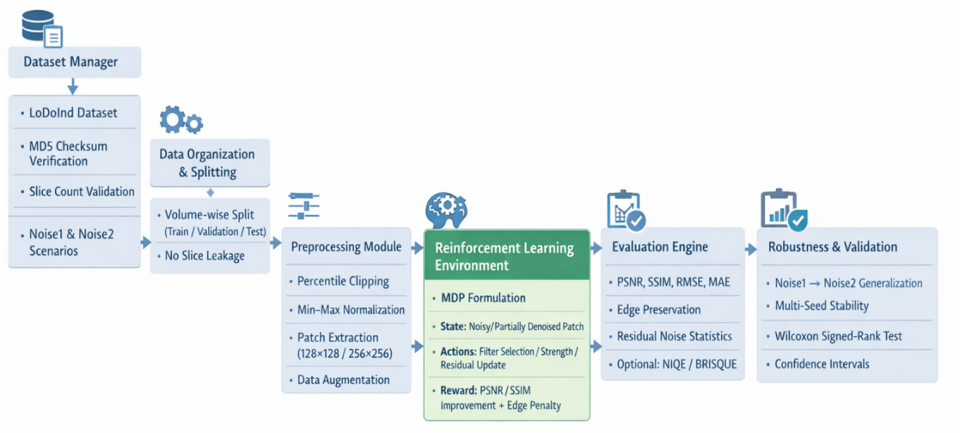
Low-dose computed tomography (LDCT) reduces radiation exposure but increases noise and structural degradation, which may affect diagnostic reliability. This paper presents a quantitative benchmarking framework to assess reinforcement learning (RL)-based LDCT denoising under standardized, reproducible experimental conditions. The proposed pipeline combines dataset splitting with controlled fragments, percentile preprocessing, classical and deep learning baselines, an RL denoising environment modeled as a Markov Decision Process, and multi-metric statistical validation. Experimental results on multi-level LDCT data show that the proposed RL_stageB model provides the highest overall reconstruction fidelity, which can achieve a mean PSNR 22.732 ± 0.947 dB and SSIM 0.929 ± 0.056, which is higher than strong classical baselines such as bilateral filtering 22.618 dB and Gaussian filtering 22.727 dB, while reducing edge distortion, Edge-L1=0.242. Statistically significant improvements (p<1e-300) are found in most comparisons using paired Wilcoxon signed-rank testing. The robustness analysis demonstrates that it maintains stable performance under both noise conditions and a small range of seed variance, with RMSE: 0.0696-0.0713. These findings present RL as an adaptive sequential denoising approach and provide a benchmarking framework for future LDCT restoration studies from a reliability perspective.
Keywords
Low-dose CT, Reinforcement learning, Image denoising, Benchmarking framework
Cite:
Pattar, A. B. ., & N, T. S. . (2026). A quantitative benchmarking framework for reinforcement learning-based low-dose CT image denoising. Future Technology, 5(3), 107–117. Retrieved from https://fupubco.com/futech/article/view/885
