Paper Title: Deep transfer learning and radiomics synergy for enhanced lung cancer classification on CT scans
Authors: Mohammed S.H. Al-Tamimi, Amenah H. Abdulateef, Isra H. Abdulateef
Corresponding Author: Mohammed S.H. Al-Tamimi (mohammed.s@sc.uobaghdad.edu.iq)/Iraq
Abstract
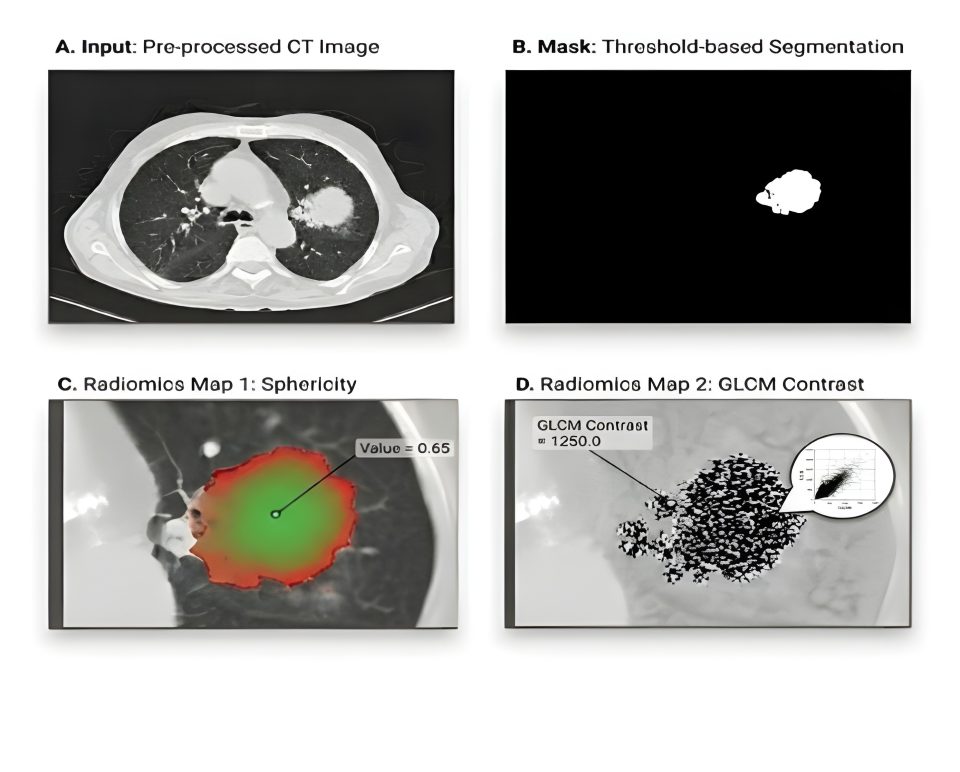
Lung cancer remains one of the leading causes of cancer-related mortality worldwide, making accurate and timely detection essential for improving patient outcomes. Computed tomography (CT) is widely used for lung assessment; however, manual interpretation can be affected by inter-observer variability and subtle imaging characteristics. This study proposes an automated three-class lung CT classification framework that integrates deep transfer learning with quantitative lung-region features. EfficientNet-B7, initialized with ImageNet-pretrained weights, was employed to extract high-level deep representations from CT images. In parallel, lung Regions of Interest (ROIs) were automatically segmented, from which four quantitative descriptors were extracted: Skewness, Kurtosis, GLCM Contrast, and GLCM Homogeneity. The standardized lung-ROI features were subsequently concatenated with the EfficientNet-B7 deep feature representation using a feature-level fusion strategy and classified into Normal, Benign, and Malignant categories. Experimental evaluation on the held-out test set demonstrated an overall classification accuracy of 96.36%, correctly classifying 106 of 110 CT images. The proposed fusion framework achieved macro-averaged Precision, Recall, F1-score, and Specificity of 94.39%, 90.87%, 92.39%, and 97.53%, respectively. Furthermore, one-vs-rest ROC analysis yielded AUC values of 0.9849, 0.9634, and 1.0000 for the Normal, Benign, and Malignant classes, respectively, corresponding to a macro-average AUC of 0.9828. These results demonstrate the strong discriminative capability of the proposed deep and quantitative feature fusion framework for three-class lung CT image classification.
