Paper Title: Global value chains, domestic value creation, and firm performance: machine learning evidence from Vietnam
Authors: Huynh Thi Thuy Giang, Nguyen Anh Phong, Tran Thi Huong
Corresponding Author: Nguyen Anh Phong (phongna@uel.edu.vn)/Vietnam
Abstract
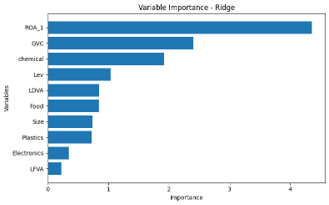
This study examines the impact of domestic value added and participation in global value chains (GVCs) on firm performance, based on a sample of 287 observations from listed companies across five key industries in Vietnam’s Southeast region during 2020-2024. Three machine learning methods, Ridge Regression, Random Forest, and Gradient Boosting, are applied to estimate the influence of each independent variable on firm performance. Ridge regression produced the best estimates of firm performance among these three model types, based on the lowest RMSE (4.97), MAE (2.78), and R-squared (0.57). This suggests that the relationship between GVC-related attributes and firm performance is largely linear and additive. Among the individual predictors, lagged profitability was the most important single predictor of current performance, followed by GVC activity. Notably, domestic added-value predicted firm performance more strongly than foreign added-value. Greater GVC activity therefore does not necessarily translate into stronger firm performance. Instead, firms appear to perform better when global engagement is combined with strong internal capabilities and substantial domestic value creation. Firm size, financial leverage, technological capability, and logistics efficiency also statistically explained variation in firm performance.
