The Incredible Engineering Behind Tires Pyrolysis Technology
A car tire is built to never fall apart. It survives 50,000 miles of heat, friction, and pressure, and when it finally dies, it still won’t break down. One billion end-of-life tires pile up every single year. Landfills leak toxic chemicals into drinking water for centuries. Burning creates some of the most toxic smoke on Earth. The world needed a third option.
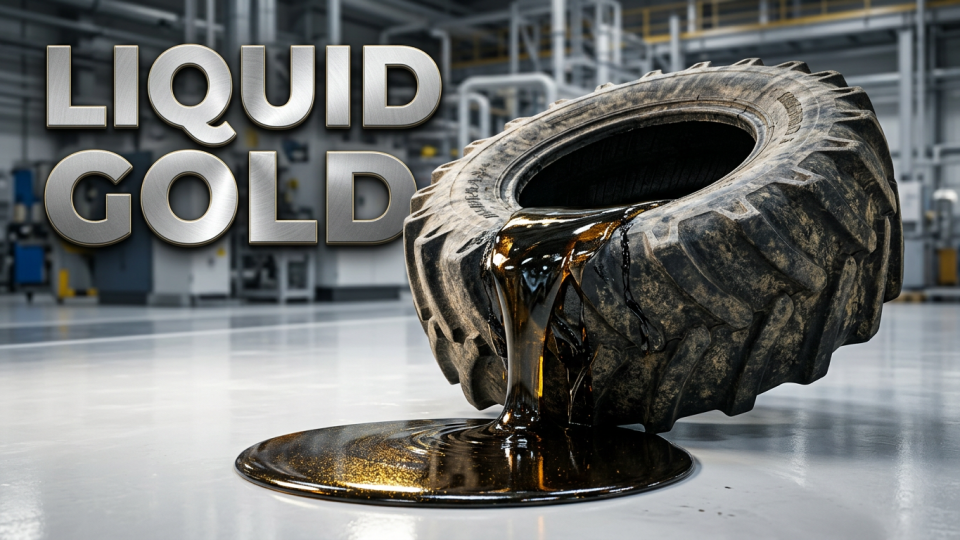
Pyrolysis is that option. Inside a completely sealed, air-free chamber heated to 500°C—hotter than molten aluminum —the rubber doesn’t burn. Instead, it quietly breaks apart into gas, then cools back into liquid fuel. One tonne of tires produces 450 liters of fuel oil. Enough to heat a large home for an entire winter.
What you will discover:
Why no air is the key: At 500°C without oxygen, rubber doesn’t combust, it thermally decomposes. Think of rubber as a string of billions of beads. Heat snaps the string everywhere at once. The short fragments float upward as gas, then cool, doing exactly what steam does on a cold window, and condense into thick, dark amber tire oil.
The shredding stage: A truck tire weighs 70kg — the same as an adult person. Industrial shredders applying the force of 80 family cars stacked on top of each other reduce it to rubber granules the size of coarse gravel in minutes. Steel wire is removed by magnetic drum separators. The rubber granules then feed continuously into the reactor.
The three products — and their market values: One tire produces three distinct commercial products. Fuel oil (46% of the tire’s mass): dark amber liquid with energy content equivalent to heavy fuel oil — usable directly in industrial boilers, cement kilns, and factory furnaces, or upgraded with one additional refining step to road-quality diesel. In 2024, $230 million was invested globally in this upgrading infrastructure. Recovered carbon black (40%): the fine black powder that makes tires black and strong in the first place. Pyrolysis returns it as a commercial product worth $3.12 billion globally in 2025 — growing at 10.2% per year. In 2024, eleven major tire companies signed long-term contracts to buy it back for new tire production. Michelin has committed to 100% sustainable materials. Steel wire (14%): at 500°C with no oxygen, the rubber around the steel cord burns away, leaving clean bare wire. Two kilograms per car tire. From one billion tires annually, that represents up to 2 million tonnes of steel recovered without mining a single tonne of iron ore. Pyrolysis gas (14%): the fraction too light to condense into liquid — piped directly back to the reactor burner as fuel. The tire literally powers the machine recycling it.
The self-fuelling loop: The lightest gases produced by pyrolysis — about 14% of the tire’s mass — do not condense into oil. Instead, they feed directly back into the reactor burner, making the process largely self-sufficient in energy. This is not a future aspiration. This is engineering already working at 2,100 facilities worldwide.
The industry at scale: More than 2,100 continuous pyrolysis units operated globally in 2024, each processing 20–24 tonnes of tires per day. Together, they produced 1.9 million tonnes of pyrolysis oil and 2.3 million tonnes of recovered carbon black in a single year. Capital investment in the sector reached $2.8 billion in 2024. The combined market for tire pyrolysis products is projected to exceed $12 billion by 2034.
Why governments are accelerating it: More than 25 countries now subsidize up to 60% of the startup cost of a pyrolysis plant. Plants also earn carbon credits for every tonne of tires recycled, creating an additional revenue stream. The EU’s Circular Economy Action Plan mandates chemical recycling pathways for tires. The financial case — product revenue plus 60% subsidy plus carbon credits — is now commercially compelling in almost every market.
The engineering challenge being solved: Older reactors suffer from temperature gradients of 50–150°C between different zones — like a casserole dish where one corner burns while another barely heats. New reactor designs using circulating liquid metal salts achieve temperature uniformity within ±5°C throughout the entire vessel — increasing oil yield by 15–20%.
From one billion tires with nowhere to go to fuel, carbon powder, and steel, extracted by 2,100 plants worldwide. The circular economy working at scale.
