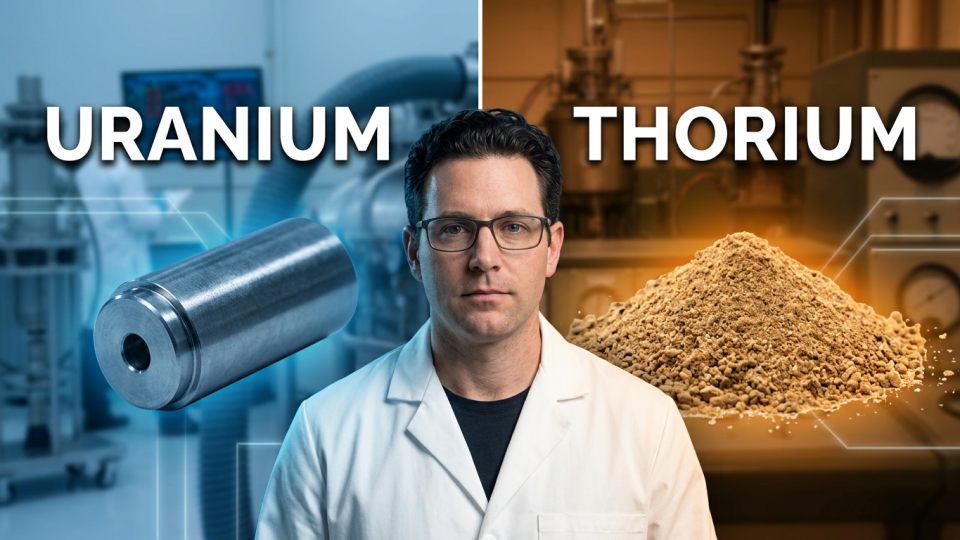
Thorium vs Uranium | Why We Chose the Wrong Nuclear Fuel 60 Years Ago
In 1965, a scientist at Oak Ridge National Laboratory built a nuclear reactor that could not melt down. It ran for 13,000 hours. When it worked perfectly, he was fired. The program was canceled. Not because it failed. Because the fuel it used — thorium — produced no plutonium for nuclear warheads. The Cold War needed uranium. So uranium won.
On November 1, 2025, China’s Shanghai Institute of Applied Physics made history. Its TMSR-LF1 thorium molten salt reactor in the Gobi Desert — built using declassified US documents from Oak Ridge — achieved the world’s first successful conversion of thorium into usable uranium-233 nuclear fuel. Three world firsts in one reactor. 60 years after America proved the concept.
The thorium case:
🌲 The science: Uranium is dry wood — ready to burn, capable of runaway. Thorium is wet wood — needs a neutron source to start. Remove the source and the reaction stops instantly. Fundamental physics makes thorium safer by design.
🧊 The freeze plug: A solid salt plug actively kept frozen by a small pump. Power fails → pump stops → plug melts → fuel drains by gravity into a subcritical tank → reaction stops automatically. No human intervention. No external power. This is what Fukushima didn’t have.
🌍 The abundance: Thorium is 3-4 times more common than uranium in Earth’s crust. Found on every continent. India holds 25% of global reserves. It is currently discarded as waste in rare earth mining. One tonne produces the same energy as 3.5 million tonnes of coal.
☢️ The waste: Uranium’s plutonium-239 stays dangerous for 24,100 years. We are building storage designed to outlast recorded civilization. Thorium cycle waste is largely safe within centuries — approximately 100 times less long-lived. Thorium reactors can also burn existing uranium waste stockpiles.
⚔️ The weapons question: Thorium cannot be directly weaponized. The U-233 it produces is always contaminated with U-232, which emits intense gamma radiation — killing handlers, detectable by satellites, destroying weapon electronics. Significantly harder to weaponize than the plutonium that uranium conveniently produces.
📜 The betrayal: Alvin Weinberg’s MSRE ran on U-233 from thorium in 1968 — a world first. The program ran successfully for 13,000 hours. The Atomic Energy Commission canceled it in 1973, choosing uranium-plutonium instead — not for technical reasons, but because plutonium was needed for Cold War weapons. Weinberg was fired in 1972 for advocating thorium.
🌏 The comeback: China has invested $444 million since 2011. India has a three-stage 70-year strategy targeting thorium. Copenhagen Atomics is building a 1 MW shipping-container pilot for 2026. Clean Core Thorium Energy has developed thorium fuel for existing reactors. The global race has begun.
The honest verdict: Thorium faces a 70-year industrial head start from uranium — no fuel supply chain, no regulatory framework, one operational experimental reactor. Molten salt corrosion at 700°C remains an unsolved engineering challenge. But on November 1, 2025, the core physics was proven at scale for the first time. The question is no longer whether thorium works. It is whether the world will act on it before 2065.
