Paper Title: Dynamic graph neural networks meet causal inference: estimating AI’s heterogeneous effects on supply chain resilience
Authors: Yang Liu, Jiaming Yang, Jian Chen
Corresponding Author: Yang Liu (3878054637@qq.com)/ Malaysia
Abstract
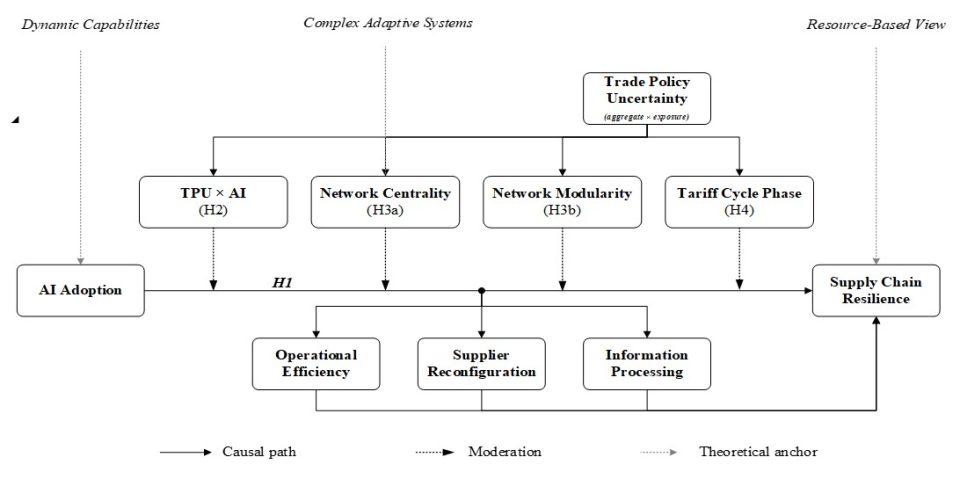
Estimating heterogeneous treatment effects in network-embedded environments requires methods that simultaneously account for relational change, conditional heterogeneity, and quasi-experimental shocks. This study proposes TGAT-CF, an approach that pairs a temporal graph attention encoder for evolving supplier-customer relationships with a generalized random forest for conditional treatment effects, triangulated against staggered difference-in-differences and double machine learning. Temporal graph embeddings replace scalar centrality as moderators, and the resulting design allows identification to be cross-checked across three estimators in settings where technology adoption unfolds inside relational dynamics. The framework is applied to a balanced quarterly panel of 2,847 Chinese A-share manufacturers over 20 quarters from 2020Q1 to 2024Q4, yielding 56,940 firm-quarter observations amid simultaneous AI diffusion and trade policy uncertainty. The temporal encoder reduces mean squared error by 21.4 percent relative to a static GraphSAGE baseline and by 6.6 to 9.4 percent relative to dynamic baselines (Diebold-Mariano, p < 0.05). A one-standard-deviation rise in AI stock raises supply chain resilience by 0.34 standard deviations, an effect that is 2.6 times larger under high uncertainty. Conditional effects differ by a factor of 2.9 between modular and centralized configurations, and the temporal profile follows a J-curve peaking at event time 2. Network centrality is the leading moderator, ahead of ownership structure, while operational efficiency, supplier adjustment, and information processing mediate nearly three-quarters of the total effect. The three estimates converge within a 7 percent band. AI capability, therefore, acts as a network-dependent, rather than a universal, determinant of supply chain resilience.
