Paper Title: A unified mathematical and computational framework for predictive analysis of complex dynamic systems
Authors: Pradeep Kumar H S, Harsha S
Corresponding Author: Pradeep Kumar H S (pradee.nie@gmail.com)/ India
Abstract
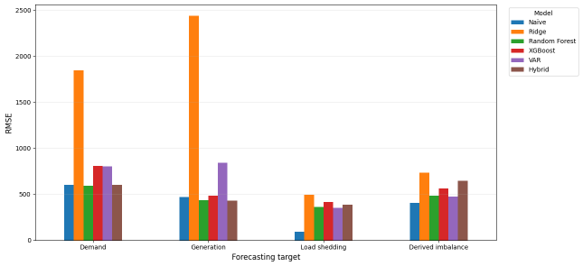
Interdependent operating states, rather than individual load curves, are increasingly required for short-term power system prediction. This study formulates and tests a common mathematical-computational approach for one-step-ahead prediction of demand, generation, load shedding, and imbalance derived from them within a dynamic grid environment. Operational data were archived as hourly data, prepared chronologically, transformed into a multivariate feature space, and split into training, validation, and test sets. The proposed framework is tested against naïve persistence, Ridge regression, Random Forest, XGBoost, and the VAR models separately and is based on a vector autoregressive mathematical core and an XGBoost residual-correction layer. In the results, the model’s effectiveness is target-dependent. The hybrid framework consistently performed best for generation and was statistically similar to the advanced models for demand, load shedding, and derived imbalance. The mathematically derived variables, source-composition features, and short-term dynamic indicators were found to have different contribution values for each target in ablation and feature-importance analyses. Stressed load-shedding conditions were also found to have lower predictive accuracy in regime-specific testing. These results show that mathematically constrained residual learning is useful for coherent forecasting of continuous operating states, while sparse stress-related variables necessitate extensions to the model to learn them in an event-aware fashion. The study offers a replicable methodology for predictive analysis of a shorter time horizon in the context of grid operation.
