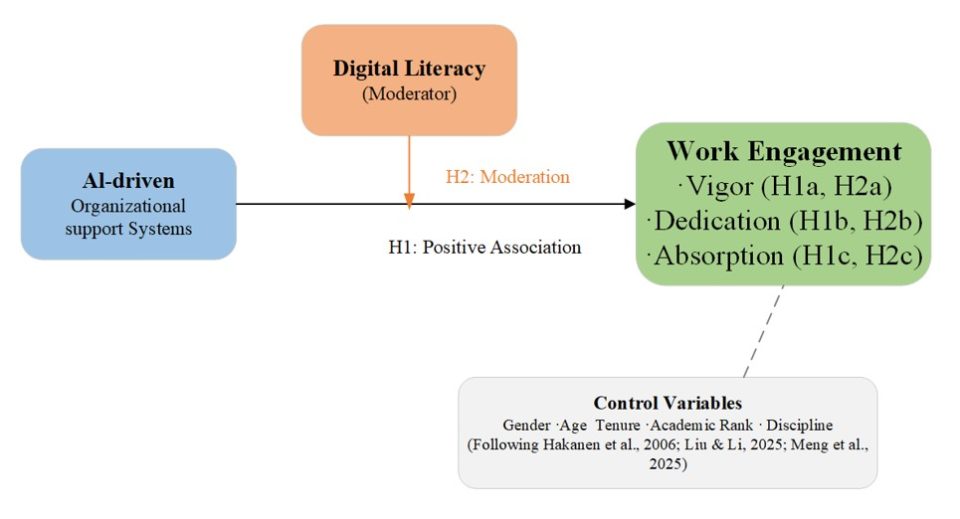
Paper Title: Research the association between AI-driven organizational support systems and university faculty work engagement: the moderating role of digital literacy
Authors: Zhixin Qian, Andi Tamsang Andi Kele, Ang Hong Loong, Pang Yeng Yuan
Corresponding Author: Andi Tamsang Andi Kele (andi@ums.edu.my)/ Malaysia
Abstract
According to the Job Demands-Resources (JD-R) model and the Technology Acceptance Model (TAM), this cross-sectional survey examined whether organizational support systems enabled by artificial intelligence (AI) were positively correlated with work engagement among university lecturers and examined the moderating role of digital literacy on 387 teachers at certain Chinese universities. With 9-item multidimensional UWES-9 vigor, dedication, and absorption scale of AI support in teaching, research, and administration domains, hierarchical regression with simple slopes, it was found AI organizational support predicted positively work engagement significantly (β=0.425, p<0.001) and explained additional 18.6% variance after controlling for demographics; digital literacy moderated this highly significantly (β=0.168, p<0.01, ΔR²=0.026), and high digital literacy faculties exhibited 2.35 times stronger strength of relations between AI support and engagement than low digital literacy faculties, and moderation being the highest for vigor dimension (β=0.185); bootstrap analysis with resamples 5,000 and sample split validation confirmed stability of such effects. By conceptualizing digital literacy as a central boundary condition, the current study extends JD-R theory to digital environments and describes another human-AI interaction in which AI complements but does not substitute human capacity and presents empirical evidence of universities to implement all-encompassing digital literacy training programs in parallel with AI system installation, although the cross-sectional study limits causal inference, findings are theoretically meaningful and practically informative and present visionary insight for knowing and promoting faculty well-being in the digital age.
Keywords
AI-driven organizational support, Work engagement, Digital literacy, Higher education, Faculty well-being, Moderation effect
Cite:
Qian, Z. ., Tamsang Andi Kele, A., Hong Loong, A. ., & Yeng Yuan, P. . (2025). Research the association between AI-driven organizational support systems and university faculty work engagement: the moderating role of digital literacy. Future Technology, 5(1), 222–233. Retrieved from https://fupubco.com/futech/article/view/623
