Paper Title: AI-enhanced spatial value reassessment in digital transformation: impacts of smart eco-city management paradigms on housing price formation mechanisms
Authors: Ping Li, Cheok Mui Yee, Wanyi He, Lijuan Lu, Kaizhou Qin
Corresponding Author: Cheok Mui Yee (cheok_my@unirazak.edu.my)/Malaysia
Abstract
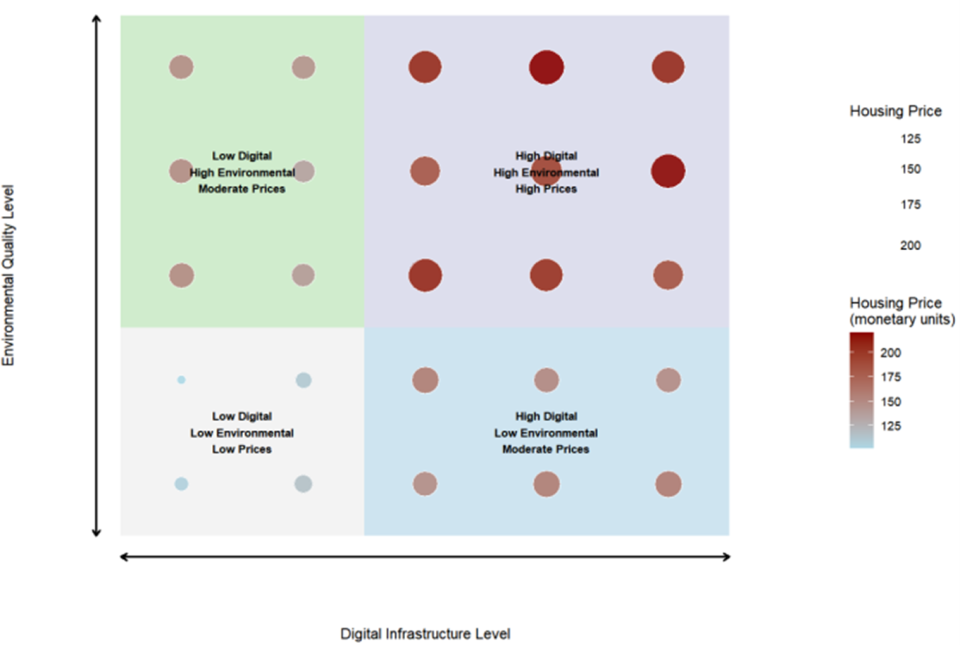
This study examines the transformative impact of artificial intelligence-enhanced smart eco-city management paradigms on spatial value assessment and housing price formation mechanisms. Through sophisticated mixed-methods analysis of 320 neighborhoods across five urban areas, employing advanced machine learning algorithms for pattern recognition, the research identifies significant synergistic relationships between digital infrastructure and environmental quality that profoundly influence housing valuations. Empirical evidence demonstrates that neighborhoods exhibiting high levels of both digital connectivity and environmental amenities command substantial price premiums of 60-100% above baseline areas, markedly exceeding the combined individual effects of digital (25-45%) and environmental (15-40%) factors alone. The strength of this synergistic relationship manifests in robust correlations between combined Digital-Environmental indices and housing prices (r = 0.83), with AI-driven predictive models achieving exceptional accuracy in forecasting spatial value shifts (R²=0.861). The study contributes a multidimensional analytical framework linking technological innovation, artificial intelligence applications, environmental governance, and housing market dynamics. Policy implications suggest the necessity for integrated governance approaches spanning digital and environmental planning spheres, with particular attention to algorithmic equity considerations given the widening price gaps between digitally-enabled and analog neighborhoods. Effective development of smart eco-cities necessitates the implementation of comprehensive strategies that not only create value through AI optimization but also ensure its equitable distribution across diverse urban communities.
Keywords
Artificial intelligence, Digital-ecological integration, Smart eco-city governance, Spatial economics of housing, Value synergy
