Paper Title: An innovative ZFFinch-MLPNet architecture for improving cyber intrusion prediction efficiency and accuracy
Authors: Dinesh Kumar Budagam
Corresponding Author: Dinesh Kumar Budagam (dbudagam@gmail.com ), United States
Abstract
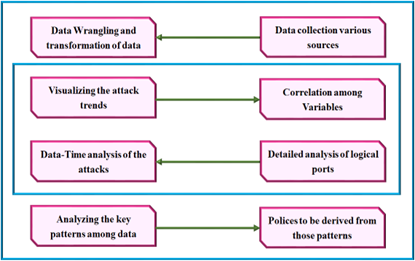
Intrusion Detection System (IDS) is one of the most significant security elements in today’s information technology-related organizations. For overcoming intrusion detection difficulties, Deep Learning (DL) has shown a significant contribution in recent times. An innovative IDS that merges the Zebra- Falcon Finch algorithm with a Multi-Layer Perceptron Recurrent Neural Network (ZFFinch-MLPNet) classifier is developed in this research. To assure data compatibility and integrity, the developed work initiates with data preprocessing comprising data inspection, handling missing values, and label encoding. Then, to recognize the structure of data, the Exploratory Data Analysis (EDA) combines correlation and visualization analysis. To enhance the intrusion detection efficacy, a Recursive Feature Elimination (RFE) is utilized to select the appropriate features. Finally, the MLPRNN classification approach with the Zebra-Falcon Finch algorithm offers flexibility, opposing overfitting, and improved accuracy. Also, for detecting network anomalies, this work addresses the developed approach’s outcomes in Python software and compares it with modern approaches. It is confirmed that the developed approach detects distinct types of network intrusions and attains better performance in identification with an accuracy of 96.20%, MCC of 92.33%, and ROC of 0.99.
Keywords
Intrusion detection system, Cyber security, Exploratory data analysis, Recursive feature elimination, MLPRNN classification, Zebra-Falcon finch algorithm
