Paper Title: Pictogram semantics standardization for barrier-free drug packaging: deep-learning-assisted design guidelines
Authors: Hui Li, Verly Veto Vermol, Zulimran Ahmad
Abstract
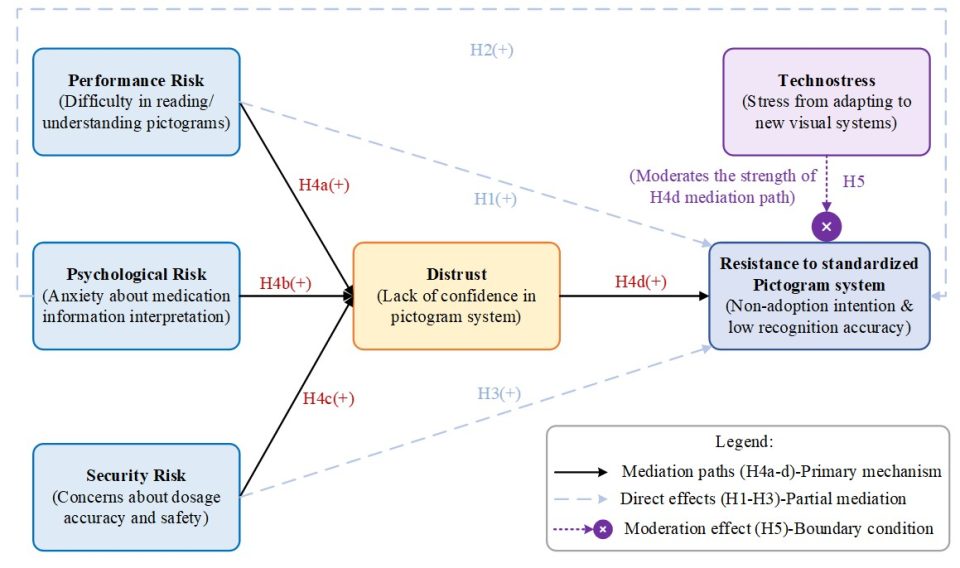
As the world gets older, elderly users find it harder to understand information on medicine packaging. This study created a framework to improve visual communication for older people using deep learning to standardize icons. The research involved 200 participants aged 60 and older who answered questionnaires and took part in interviews, while deep learning models were trained with 1,500 medicine icons. The Residual Network-50 (ResNet-50) model reached 94.8% accuracy, outperforming VGG-16 (89.6%) and Vision Transformer (92.1%), in recognizing meanings across 21 icon types. Analysis showed that performance risk, psychological risk, and safety risk affect how older users accept these icons, with distrust playing a role (R²=0.723), and psychological risk being responsible for 54.6% of the indirect effect. Testing showed that using standardized icons raised recognition accuracy from 68.3% to 92.5% and cut down comprehension time by 52%(t=9.87, p<0.001, Cohen’s d=2.21). The recommended design standards (icon diameter ≥20mm, font size ≥14pt, contrast ratio ≥7:1) give measurable guidelines for the medicine industry and are important for encouraging healthy aging.
Keywords
Deep learning, Icon semantic standardization, Age-friendly design, Pharmaceutical packaging, Accessible design
Cite:
Li, H., Veto Vermol, V., & Ahmad, Z. . (2025). Pictogram semantics standardization for barrier-free drug packaging: deep-learning-assisted design guidelines . Future Technology, 5(1), 135–147. Retrieved from https://fupubco.com/futech/article/view/599
