Paper Title: Spatial–temporal machine learning for traffic violation type prediction: a case study in Qatar
Authors: Vishal Anand, Apoorva Singh, Anuj Kumar Singh, Dal Chandra, Rahul, Navpreet Singh, Krishna Kumar
Corresponding Author: Vishal Anand (vishalanand.law@gmail.com)/India
Abstract
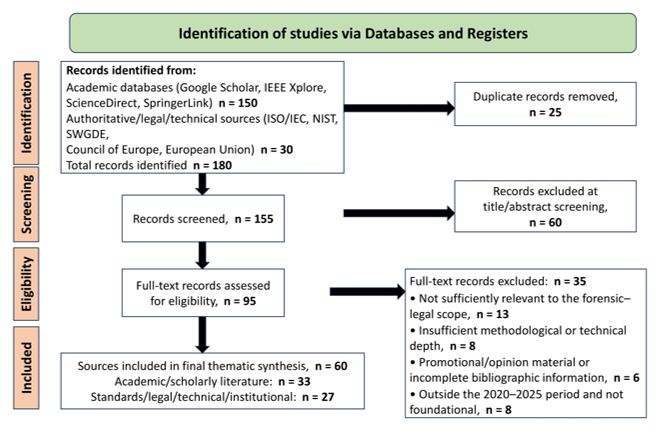
Linked authenticity, integrity, reliability, attribution, jurisdiction, and privacy challenges are created by digital evidence from cloud platforms, Internet of Things (IoT) devices, artificial intelligence (AI), large language models (LLMs), biometrics, drones, blockchain, and virtual environments. This review synthesizes scholarly and authoritative sources on cybercrime law, digital forensics, and emerging technologies through a structured narrative review. The review reveals a technical–legal divide: it emphasizes investigative efficiency, while acquisition, hashing, metadata, chain of custody, tool validation, and automated-analysis reliability require clarification for evidentiary scrutiny. Technology, evidence source, forensic challenge, legal risk, admissibility requirement, and governance response are linked through the Technology–Forensic–Legal Admissibility (TFLA) Framework. Primary artifacts are distinguished from analytical outputs; technical weaknesses are translated into legal consequences and safeguards. Standards and evidentiary rules are complemented; TFLA is conceptual, not empirically validated. Technology-neutral, technically informed, rights-compliant governance is supported through transparent documentation, corroboration, human oversight, and institutional competence. Digital-forensic system design is linked to trustworthy technology governance.
