Paper Title: AI-driven assessment of urban greenway restorative environments: integrating deep learning, street view imagery, and environmental psychology
Authors: Xueyan Jing, Mohd Fabian Hasna, Aini Jasmin Ghazalli
Corresponding Author: Xueyan Jing ( gs64663@student.upm.edu.my)/Malaysia
Abstract
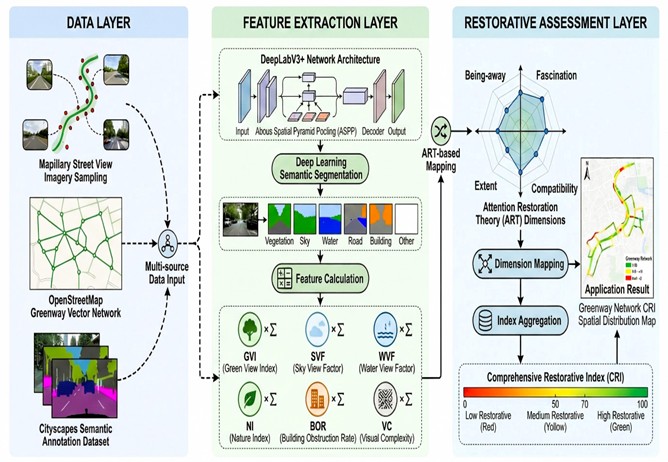
Existing methods for evaluating urban greenway restorative environments lack objectivity, efficiency, and theoretical integration. The purpose of this research is to develop a restorative environmental assessment framework for urban road binding using deep learning, street-view image data, and environmental psychology theory. It uses a semantic segmentation model called DeepLabV3+ to collect six visual environment features which are otherwise difficult to represent numerically. At the same time, it offers a methodological path for the interdisciplinary integration of artificial intelligence technology and environmental psychology theory. The calculation model of the comprehensive recovery index is constructed in four dimensions based on attention recovery theory. According to empirical analysis, this framework can successfully identify systematic differences in the restorative dimension of different types of binding paths. The presence of greenness can make a large positive contribution to the restorative effect, while building occlusions can have an inhibitory effect. The evaluation results are quite consistent with theoretical predictions and have good robustness in parameter Settings. The findings of the study offer a scientific evaluation tool for accurate diagnosis and optimization improvement of the urban road binding restorative environment. At the same time, it offers a methodological path for the interdisciplinary integration of artificial intelligence technology and environmental psychology theory.
Keywords
Urban greenway, Restorative environment, Deep learning, Street view image, Attention recovery theory
Cite:
Jing, X., Fabian Hasna, M., & Jasmin Ghazalli, A. (2026). AI-driven assessment of urban greenway restorative environments: integrating deep learning, street view imagery, and environmental psychology. Future Technology, 5(2), 228–240. Retrieved from https://fupubco.com/futech/article/view/758
