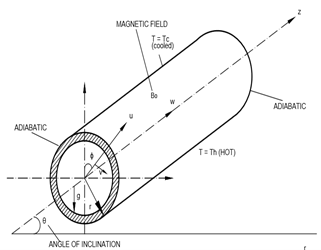
Paper Title: Numerical study of MHD mixed convection in an oriented elliptic geometry under the influence of some selected geometrical variables and fluid flow properties saturated with Al2O3-water nanofluid
Authors: Adekeye, P.O. Okekunle, I. K. Adegun
Corresponding Author: T. Adekeye (tundeadekeye2008@gmail.com)/Nigeria
Abstract
This study numerically investigated the effects of some selected geometrical parameters, such as inclination angles, eccentricity, and some fluid flow properties, such as nanoparticle volume fractions, Grashof, Hartmann, Reynolds, Prandtl, and Richardson numbers, on fluid flow pattern (velocity profiles), temperature history, and heat transfer rate in an inclined elliptic configuration filled with Al2O3-H2O nanofluid. The non-dimensional governing equations were developed for the elliptic geometry. The lower wall of the configuration was subjected to continual heat flux, and the top wall was retained at a persistent cold temperature (Tc) while the cross-sectional ends of the configuration were presumed to be insulated. The normalized controlling equations were explained using a 4th order Alternating Direction Implicit (ADI) scheme with the Gauss-Seidel iteration technique. A computer code was written with Python 3.X version to simulate the fluid flow and heat transfer in the enclosure. The numerical results obtained exhibited that fluid flow circulation deteriorated with increasing Hartmann number and increasing nanoparticle volume fraction individually. The rate of heat transfer (Nu) augmented with fluid flow circulation for the range of Grashof at 104-106 and φ=0.0-0.045, respectively. The temperature field decreased with increasing nanoparticle volume fractions (0.00, 0.025, and 0.045). It was revealed from the outcomes that the optimum heat transfer rates were attained in the configuration for eccentricity, e value at 0.866, and inclination angle in the range , correspondingly. The average rate of heat transfer is elevated with increasing Reynolds number under laminar conditions. The results obtained could be applied in metallurgical industries where a magnetic field is used to regulate the flow of hot fluid. It could also be useful in the development of a model for designing a compact MHD heat exchanger for industrial applications.
Keywords
Elliptic configuration, Al3O2-water nanofluid, MHD Fluid flow, Heat transfer, Velocity profiles, Temperature field
Cite:
Adekeye, T., P.O. Okekunle, and I.K. Adegun. 2025. “Numerical Study of MHD Mixed Convection in an Oriented Elliptic Geometry under the Influence of Some Selected Geometrical Variables and Fluid Flow Properties Saturated With Al2O3-Water Nanofluid”. Future Energy 5 (1). https://fupubco.com/fuen/article/view/721.
