Paper Title: The impact of AI-driven industrial upgrading on economic development
Authors: Xiaofei Hao, Aotip Ratniyom, Sivalap Sukpaiboonwat
Corresponding Author: Aotip Ratniyom (aotip.ratniyom@gmail.com)/Thailand
Abstract
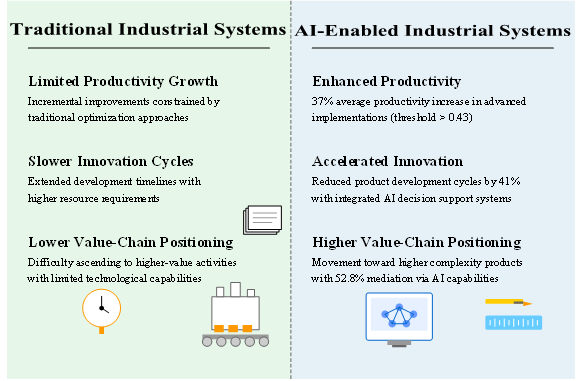
The paper clarifies the interdependencies between AI adoption, industry upgrading, and economic development in the context of global digital transformation. With mixed-methods integrating econometrics and case studies, we test models formalizing mediating and threshold effects in AI-industry-economy relations. Our approach leverages a novel AI penetration score by industries alongside economic indicators and measures of industry sophistication. The results indicate that AI uptake mediates the pass-through of industry structure change to economic performance, with contribution levels increasing above certain thresholds. Evidence suggests that the association between the working-age population and economic growth varies by alternative industry upgrading rankings, with technologically sophisticated structures making better use of demographic opportunities. Threshold analysis identifies regimes where AI substitutes for traditional economic relations, revealing policy intervention points. These findings contribute to growth theory innovation by measuring AI’s catalytic economic function and offer methodological innovation in the analysis of technological contributions. Strategic AI development agendas, human capital policies, and coordination mechanisms are among the key implications required to achieve inclusive growth in the digital economy. This study closes knowledge gaps on how demographic and technological drivers interact through industry structures to determine economic trajectories. Empirical results show that AI adoption mediates 52.8% of manufacturing sophistication’s impact on GDP growth, threshold effects emerge at an AI adoption index of 0.43-0.45, where economic impacts increase threefold, and the working-age population’s growth effect varies from 0.072 below the threshold to 0.411 above the threshold in the highest industrial upgrading quartile.
Keywords
Artificial intelligence, Industrial upgrading, Economic development, Threshold effects, Working-age population, Digital transformation
